
Kalam IAS Academy was founded by a team of committed individuals who believe that the traditional way of UPSC preparation needs to be changed.

TH Text & Context: What constitutes as contempt of court in India?
Syllabus: Pre/Mains – Polity
Why in News?
Recent controversy over alleged contemptuous remarks against the CJI & Supreme Court → seen as undermining judicial authority & administration of justice.
Constitutional Basis
- Art. 19(2) → permits restriction on free speech for “contempt of court.”
- Art. 129 (SC) & Art. 215 (HC) → Courts of Record → decisions preserved for precedent + inherent power to punish for contempt.
- Contempt of Courts Act, 1971 → codifies procedure & defines types of contempt.
Types of Contempt
- Civil Contempt (Sec. 2(b)) → Wilful disobedience of judgment/decree/order/writ or breach of undertaking.
- Criminal Contempt (Sec. 2(c)) → Publication/act that:
- (i) Scandalises or lowers authority of court.
- (ii) Prejudices/interferes with judicial proceedings.
- (iii) Interferes with administration of justice in any other way.
- Initiation → Suo motu by SC/HC or on motion with AG/Advocate General’s consent.
Judicial Interpretation
- Fair Criticism ≠ Contempt → Legitimate academic/legal critique permitted.
- Ashwini Kumar Ghosh v. Arabinda Bose (1952) → Fair commentary allowed; excess = contempt.
- Anil Ratan Sarkar v. Hirak Ghosh (2002) → Punishment only when clear violation proven.
- M.V. Jayarajan v. High Court of Kerala (2015) → Abusive public remarks = criminal contempt.
- Shanmugam @ Lakshminarayanan v. High Court of Madras (2025) → Purpose of contempt law = protect administration of justice.
Broader Democratic Context
- Judiciary → guardian of constitutional morality & justice delivery.
- Misrepresentation/derogatory attacks → undermine public faith → threaten democratic principles.
- Democratic criticism
 ; Malicious defamation → affects judicial independence & substantive justice.
 ; Malicious defamation
  → affects judicial independence & substantive justice.
Test Your Knowledge 01
Q. Which of the following correctly distinguishes “court of record” as defined under the Indian Constitution?
(a) A court whose records cannot be questioned in any other court and which has the power to punish for contempt.
(b) A court whose proceedings are mandatorily recorded in writing but without inherent contempt power.
(c) A court whose judgments require Presidential authentication to become enforceable.
(d) A court that functions only as an appellate authority for subordinate courts
Hint: Art. 129 (SC) & Art. 215 (HC) → courts of record → judgments preserved as evidence + inherent contempt power
TH Science: Clearest black hole merger signal yet allows probe of Hawking’s law
Syllabus: Pre/Mains – Science & Tech
Why in New?
LIGO–Virgo–KAGRA reported GW250114 (Jan 14, 2025): clearest BH merger signal yet → strongest test of Hawking’s black-hole area theorem.
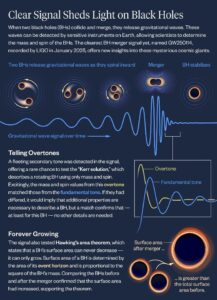
Event & signal
- Source → BH–BH merger @ ~1.3 bn ly; near-equal masses (~30 M☉ each), low/no spin, ~circular orbit
- Signal quality ↑ → highest SNR so far; clear inspiral–merger–ringdown “cosmic bell”
Detectors & methods
- Network → LIGO (2 × 4 km), Virgo, KAGRA; laser interferometry in ultra-high vacuum
- Searches → model-agnostic (excess power) + model-dependent (matched BH templates) → consistent detection
- Data sharing → joint pipelines; cross-checks across sites
Instrumental advances (why clearer)
- Laser noise ↓; mirror surfaces cleaner; calibration uncertainty ↓
- Multiple bounces (~300) in arms → path-length sensitivity ↑
Key findings: Hawking area theorem (1971)
- Approach → separate fits: early inspiral vs post-merger ringdown
- Extracted areas → A_initial (BH1 + BH2) vs A_final (remnant)
- Result → A_final > A_initial (✦ strongest observational support yet)
- Implication → entropy-like BH area never ↓; GR consistent in strong-field
Additional GR tests
- Ringdown modes → ≥2 quasinormal frequencies identified → “Kerr-like” spectrum
- Kerr solution (1963) → remnant consistent with rotating Kerr BH; damping rates/frequencies match expectations
Error control & robustness
- Systematics mapped → calibration checks; noise artifacts vetted; selection of quiet data segments
- Astrophysical assumptions probed → circular vs eccentric orbits; consistent outcomes
- Dominant uncertainties understood/controlled → conclusions stable
Context & significance
- Benchmarks → echoes of first GW event (2015) but with far clearer signal
- Catalogue growth → improves BH population inferences (mass, spin, formation channels)
- Outlook → decade-2 of GW astronomy → tighter tests of GR, horizon physics, BH thermodynamics.
Test Your Knowledge 02
Q. According to Hawking’s black-hole area theorem (1971):
(a) The mass of a black hole can decrease due to radiation.
(b) The total entropy of black holes decreases after a merger.
(c) The total event horizon area never decreases in any classical process.
(d) The temperature of a black hole is directly proportional to its mass
IE Explained: Why Bill Gates’ changed climate views are in step with India’s
Syllabus: Pre/Mains – Environment
Why in News?
Bill Gates’ latest climate memo shifts focus from mitigation (emission cuts) → adaptation (resilience building), aligning closely with India’s stance on climate action.

Gates’ Shift in Climate Perspective
- Core Idea → ↓ “Doomsday” view; ↑ focus on resilience, health, prosperity.
- 3 Key Points
- →Climate change serious but not existential.
- →1.5°C–2°C targets ≠ only solution.
- →Development (↑ agri, health, infra, early warning) = best defence.
- Criticism → Climate scientists (Michael Mann, Hayhoe) warn it may ↓ urgency for emission cuts.
- Supporters → Argue realism: mitigation progress minimal, adaptation gives immediate/local gains.
Mitigation vs Adaptation Debate
- Old Debate → Both essential but trade-offs inevitable in resource-limited world.
- Mitigation limits →
• Global emissions ↑; ↓43% by 2030 target unrealistic.
• CO₂ longevity (centuries) → no quick climate impact even if net-zero now. - Adaptation benefits →
• Immediate life-saving returns (e.g., early warning systems).
• Local relevance → appeals to developing nations.
• Yet only ~20% of global climate finance → adaptation.
Alignment with India’s Climate Position
- India’s 2024 Economic Survey →
• Called temp-target approach “flawed”.
• Advocated development-first → ↑ income, ↑ resilience.
• Criticized elevation of emission cuts “to pinnacle” of policy.
• Sought space for growth + green transition together. - Convergence → Gates’ memo echoes India’s logic → growth & resilience key to climate security.
Broader Global Context
- Developing Countries → Welcome Gates’ realism; demand ↑ adaptation finance & tech support.
- Risk → Misuse by climate denialists (e.g., Trump’s “hoax victory” remark).
- China Example →
- 4× emission rise since 1990s → but rapid prosperity & tech base built.
- Now leading in renewables; can decarbonise faster than West.
- Illustrates: growth → capacity → later rapid emission cuts.
Implications
- Policy → Shift toward balanced climate strategy: “Prosper first, decarbonise faster later.”
- Finance → Likely ↑ push for adaptation funds in COP agendas.
- Narrative → Reframes climate action from fear to pragmatic resilience-building — led by developing world voices like India.
Test Your Knowledge 03
Q. Which of the following correctly differentiates carbon neutrality and net-zero?
(a) Carbon neutrality includes all GHGs; net-zero only CO₂.
(b) Net-zero includes all GHGs; carbon neutrality only CO₂.
(c) Both are identical in definition.
(d) Carbon neutrality ignores offsets; net-zero does not.
Hint: Net-zero → includes all greenhouse gases; carbon neutrality → only CO₂ balance
