
Kalam IAS Academy was founded by a team of committed individuals who believe that the traditional way of UPSC preparation needs to be changed.

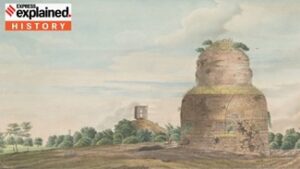
IE Explained: Tracing history of Sarnath: from Buddha’s first sermon to emblem of Indian republic
Syllabus: Pre/Mains – History
Why in News?
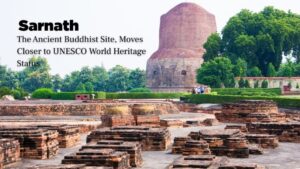
India nominated Sarnath for UNESCO World Heritage List (2025-26 cycle); ASI to install corrected plaque crediting Babu Jagat Singh (1787-88) for rediscovery.
Origins & Early History
- Buddha’s first sermon: c. 528 BCE, Mrigadava/Rishipatana
- Formation of Sangha (first Buddhist community)
- Ashoka (268–232 BCE): lion capital pillar (now Indian emblem), Dhamek Stupa, monasteries, pilgrimage centre
- Pre-Ashokan habitation evidence
Later Patronage & Decline
- Kushana (1st–4th CE) & Gupta (3rd–6th CE): refurbishments, new structures
- Flourishing monastic centre till 12th CE
- Destruction (12th CE):
- Likely 1193, Qutb-ud-din Aibek invasion → temples destroyed, monks fled
- Alternative theory: mid-12th CE Saivite temple project (unfinished) → later Muslim invasion
- Site abandoned ~7 centuries; Buddhism declined in India
Rediscovery & Excavations
- 1787-88: Jagat Singh’s workers uncover relics while digging for Jagatganj market
- 1799: Jonathan Duncan reports findings
- 1835–36: Alexander Cunningham excavations, statues removed, site identified as Buddha’s first sermon location
- 1904–05: Friedrich Oertel systematic excavation → 476 relics, 41 inscriptions
- Sarnath established as major archaeological & religious site
Modern Importance
- Among four holiest Buddhist sites (with Lumbini, Bodh Gaya, Kushinagar)
- National emblem: Lion Capital of Ashoka
- Tourism & Pilgrimage: ~8.4 lakh visitors (2024–25)
- Pending World Heritage status (27 years on tentative list)
Test Your Knowledge 01
Q1. Consider the following statements regarding Sarnath:
- It is the place where the Buddha delivered his first sermon and the Sangha was formed.
- The Lion Capital of Ashoka at Sarnath is the National Emblem of India.
- The Dhamek Stupa at Sarnath is believed to mark the exact spot of Buddha’s Mahaparinirvana.
- Sarnath remained a thriving monastery until the 12th century CE.
Which of the above statements is/are correct?
(a) 1, 2 and 4 only
(b) 1 and 3 only
(c) 2 and 4 only
(d) 1, 2, 3 and 4
Hint: Mahaparinirvana took place at Kushinagar, not Sarnath.
TH Text & Context: How does SC’s order affect Waqf law?
Syllabus: Pre/Mains – Polity
Why in News?
SC (15 Sept 2025) stayed select provisions of Waqf (Amendment) Act, 2025, citing risk to property rights & minority autonomy.
Waqf Law & 2025 Amendments
- Waqf: Permanent charitable endowment under Islamic law.
- Key amendments:
- Collector power to decide govt vs waqf land.
- Only property owner + practising Muslim (≥5 yrs) can create waqf.
- Abolition of “waqf by user.”
- Non-Muslim representation on Waqf Boards/Council; CEO need not be Muslim.
- Central digital registration of properties.
- Limitation Act applicability.
Grounds of Challenge
- Article 26: Right to manage religious affairs.
- Article 30: Minority right to manage institutions.
- Arbitrary 5-yr practising Islam clause.
- Collector powers violate separation of powers.
- Non-Muslim inclusion undermines autonomy.
- Deletion of waqf by user → loss of traditional recognition.
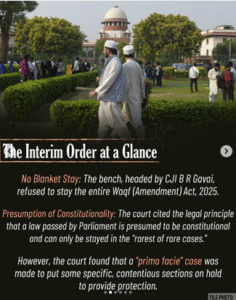
SC Interim Order
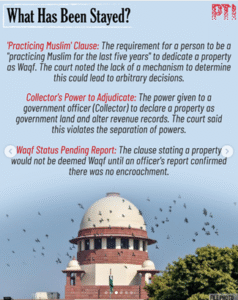
Stayed
- Collector’s unilateral inquiry into waqf property (Sec 3C).
- Automatic loss of waqf status once inquiry begins.
- 5-yr practising Islam requirement → suspended till rules framed.
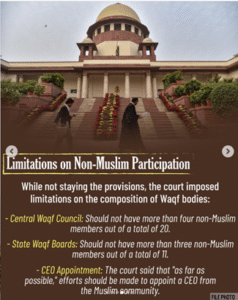
- Cap on non-Muslims: max 4 in Central Council, 3 in State Boards.
- Advisory: CEO of Waqf Board preferably Muslim.
- Waqf cannot cover ST land, protected monuments.
Upheld
- Abolition of waqf by user (prospective).
- Central digital registration of properties.
- Limitation Act, 1963, applies to waqf properties.
- Dedication allowed only from one’s own property.
Broader Implications
- Minority Rights: Balancing autonomy vs transparency; intrusion fears remain.
- Separation of Powers: Judicial check on executive property adjudication.
- Religious Freedom: 5-yr clause risks policing religiosity; subject to future scrutiny.
- Accountability: Digital registry, limitation law → transparency, curb misuse.
- Pluralism: Limited non-Muslim representation—oversight vs autonomy tension.
- Property & Tribal Rights: Protection for ST land, monuments reaffirmed
Test Your Knowledge 02
Q2. The “Waqf by user” doctrine, recently in news, refers to:
(a) Recognition of land as waqf based solely on continuous religious or charitable use, even without formal deed.
(b) Dedication of property by any Muslim, regardless of ownership, through oral declaration.
(c) Automatic vesting of any unused land in the Waqf Board.
(d) Government’s power to reassign waqf land for public use after prolonged non-use.
Hint: Historical recognition principle, now abolished prospectively.
IE Opinion: India’s Census delay and the problem of unequal representation
Syllabus: Pre/Mains – Governance
Why in News?
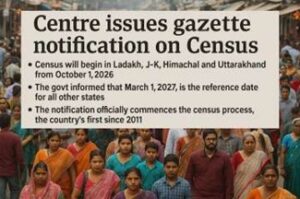
Census delayed since 2011; next in 2027 → 16-year gap → unequal electoral representation.
Problem
- Delayed Census: 2021 postponed (Covid-19); 16 years since 2011.
- Outdated Constituencies: Based on 2011 data → mismatch with current population.
- Political Equality Issue: Weakens “one person, one vote, one value”.
- No Deadlines: Census Act, 1948 & Delimitation Acts → vague, no timelines.
- Representation Crisis: Fast-growing cities under-represented; slow-growth regions over-represented.
Constitutional & Legal Context
- Art. 82: Delimitation after every Census.
- Delimitation Commission: Ad hoc, no strict time limits.
- 2002 Case: Initially based on 1991 data; amendment allowed 2001 data → revealed flaw.
Global Best Practices
- Indonesia: Census every 10 yrs, timely redistricting.
- Philippines: Census every 5 yrs, quick adjustments.
- Thailand: Census cycle linked directly to redistricting.
Implications of Delay
- Urban Under-representation: Population ↑ but seats unchanged.
- Rural Over-representation: Population growth slower but same seat strength.
- Democratic Deficit: Electoral map detached from present realities.
- Cascading Effect: Delimitation stalled → fair elections undermined.
Reform Measures (Proposed 4 Steps)
- Amend Census Act, 1948 → mandatory every 10 yrs.
- Publish Census data for delimitation within 1 yr.
- Amend Art. 82 → delimitation to begin within 6 months of data release.
- New Delimitation Act → hard 2-yr deadline for completion.
Core Idea – Conclusion
Predictable, time-bound Census + Delimitation = uphold political equality & democratic legitimacy.
Test Your Knowledge 03
Q3. With reference to the Census in India, consider the following statements:
- The Census Act, 1948 makes it mandatory to conduct a Census every ten years.
- The Census Commissioner of India functions under the Ministry of Home Affairs.
- The Census data must be published within one year of enumeration, as per law.
Which of the above is/are correct?
(a) 1 only
(b) 2 only
(c) 1 and 3 only
(d) 2 and 3 only
Hint: The Act does not fix periodicity or publication timeline, only gives framework; administrative control is with MHA.
IE Opinion: From Nepal to Sri Lanka and Bangladesh, a crisis of democracy that has lessons for India
Syllabus: Pre/Mains – International Relations
Why in News?
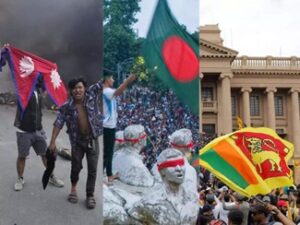
Recent uprisings in Sri Lanka (2022), Bangladesh (2024) and Nepal (2025) toppled elected governments, raising concerns about democratic crises in South Asia and lessons for India.
Regional Democratic Crises
- Sri Lanka (2022)
- Aragalaya protests → corruption, economic collapse, Rajapaksa misrule
- Palace stormed, PM’s house torched
- Only 10 deaths, 250 injured
- New govt 2024 → leftist youth leader Anura Kumara Dissanayake elected
- Bangladesh (2024)
- Sheikh Hasina accused of autocracy, 4th rigged election
- July Uprising: 21 days, triggered by student Abu Sayed’s killing
- Violence: 834–1,581 dead, including children
- Hasina fled to India, interim govt under Muhammad Yunus
- Nepal (2025)
- Youth anger: corruption, unemployment, elite “nepo-kids” vs poor masses
- Oli govt banned social media → triggered protests
- Mobilisation via Discord, VPNs, Instagram
- Youth “digitally elected” ex-CJ Sushila Karki as PM
Common Drivers
- Rising youth unemployment
- Rampant corruption across parties
- Autocracy, election rigging, weak institutions
- Social media & digital natives as mobilisation tools
- Disconnect: electoral democracy ≠ real public will
Lessons for India
- Youth Unemployment
- 35.9% (ages 20–24, CMIE July 2025) + underemployment crisis
- Corruption & Money Power
- All parties dependent on corporate, trade, local “goon” funding
- Quid pro quo politics entrenched
- Institutional Weakness
- No inner-party democracy; parties as “private limited companies”
- Bureaucracy compromised for posts
- Judiciary timid/vacillating; some compromised
- Elections & Trust Deficit
- Opposition alleging “vote theft” by Election Commission
- Growing public disaffection with entire political class
Broader Concerns
- Plato: democracy prone to mob rule, tyranny
- Aristotle: swayed by emotion/demagogues
- Warning signals: collapse of “functional democracies” next door
- Without internal democracy in parties → cannot sustain real democracy
Test Your Knowledge 04
Q4. Which of the following statements best describes the nature of political parties in India?
(a) Parties operate as open, democratic institutions with regular internal elections.
(b) Parties are largely like “private limited companies” tightly controlled by leadership.
(c) Parties are regulated and controlled directly by the Election Commission to ensure transparency.
(d) Parties have successfully reduced dependence on industry and local funding
Hint: No inner-party democracy; family/leader-centric control.
IE Opinion: A future-ready disaster management in the Himalaya requires a massive technology scale-up
Syllabus: Pre/Mains – Disaster Management
Why in News?
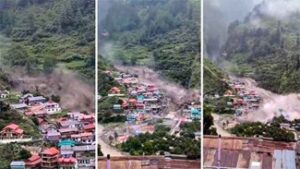
Monsoon 2025 floods across J&K, Himachal, Punjab, Uttarakhand exposed both strengths and gaps in Himalayan disaster management.
Current Response: Strengths
- Multi-agency action: Army, IAF, ITBP, NDRF, SDRF, BRO, local police, volunteers.
- Examples:
- Army Bailey bridges (J&K), 36-hr DC trek (Uttarakhand).
- Pilgrim evacuations: Machail, Vaishno Devi, Manimahesh Yatra.
- BRO road/bridge restoration.
- Drone imagery, satcom revival, Chinook heavy lifts, aerial cableway.
- NDMA–CWC–IMD coordination (Punjab dams).
- Innovation: Drones, OneWeb satcom, Doppler radars, IMD nowcasting.
Gaps & Challenges
- Tech limits: Inadequate landslide mapping, sparse doppler network, weak glacial lake monitoring.
- Human behaviour: Low awareness despite SMS/Sachet app alerts; continued pilgrim footfall during red alerts.
- Development risks: Riverbed construction, slope destabilisation, poor enforcement of building norms.
- Institutional gaps: Mock drills tokenistic, NDMA outreach shallow, limited community penetration.
Technology Scale-Up: Future Needs
- Mapping & monitoring: GSI slope/soil studies, NRSC 24×7 glacial lake watch.
- GIS risk mapping: Valley-wise hazard zoning.
- Predictive tools: AI + local hydro-met data → flash flood/cloudburst forecasts.
- Drone use: Move beyond damage assessment → predictive slope/glacier surveillance.
- Dense radar grid: Valley-specific dopplers, localised warning systems.
- Urban flood models: Replicate Gorakhpur model.
Community & Governance
- Citizen preparedness: Know evacuation routes, shelters, response steps.
- Training: Expand Aapda Mitra to schools, panchayats, RWAs.
- Mock drills: Regular, mandatory, realistic.
- Civil society role: Local knowledge integration in DDMA.
- Enforcement: Seismic codes, no-build river zones, regulate mining.
Recovery & Resilience
- Build Back Better: Slope-stabilised roads, reinforced embankments.
- Sustainable practices: Eco-sensitive construction, resilience-based planning.
- Professional cadre: Disaster-tech specialists across states.
- Armed forces: Ongoing disaster management training, integration with civilian systems
Test Your Knowledge 05
Q5. With reference to disaster management in the Himalaya, which of the following technologies are already in use in India’s response efforts (2025)?
- Drone imagery for damage assessment
- Satellite communication links (OneWeb, satcom)
- Doppler radars for nowcasting
- Artificial intelligence–based flash flood prediction
Select the correct answer:
(a) 1 and 2 only
(b) 1, 2 and 3 only
(c) 2, 3 and 4 only
(d) 1, 2, 3 and 4
Hint: AI forecasts are a “future need,” not yet mainstream in 2025
Q6. The Aapda Mitra programme primarily aims at:
(a) Developing early warning systems using AI and GIS tools.
(b) Training community volunteers in disaster preparedness and response.
(c) Providing insurance cover to disaster-affected households.
(d) Financing resilient infrastructure in fragile Himalayan states.
Hint: Focus is on community-level capacity.
What to know about upcoming F1 rule changes in 2026, biggest in a generation?
Why in News?
FIA introducing sweeping F1 rule changes from 2026, termed biggest in a generation.

Key Changes
- Car Design & Performance
- Lighter, smaller, more agile cars
- Aerodynamics simplified → closer racing
- Reduced downforce drag; focus on efficiency
- Engines (Power Units)
- Turbo-hybrid retained (since 2014)
- 50% power from electric energy (vs ~20% now)
- 100% sustainable fuels mandated
- More standardised parts to cut costs
- Competitiveness & Cost Cap
- Possible wider performance gaps (Pirelli: up to 4 sec/lap variance)
- “107% rule” unlikely to disqualify cars
- Cost cap strict, but exemptions for struggling manufacturers
- FIA checks every 6 races → allow limited overspend for engine catch-up
- Driver Skill & Energy Management
- Energy deployment (battery/turbo) key race skill
- FIA balancing automation vs driver input
- Goal: avoid “chess-like” over-management
- Safety & Sustainability
- Crash structures reworked → higher safety
- Cars ~30% more energy-efficient
- Ban on harmful materials; reduced emissions
- Rain & Visibility
- New floors → less spray
- Aim to enable proper wet racing (avoid 2021 Belgium GP repeat)
- Ongoing FIA projects for visibility solutions
Implications
- Mercedes likely engine leader; newcomers (Audi, Ford-Red Bull, Honda return) face learning curve
- Teams prioritising 2026 over 2025 car dev → possible performance disparities
- Regulations seek: closer racing, sustainable tech showcase, financial stability, better fan experience
