
Kalam IAS Academy was founded by a team of committed individuals who believe that the traditional way of UPSC preparation needs to be changed.

IE Explained: Rationalise tariffs, independent of US pressure, and raise productivity
Syllabus: Pre/Mains – International Relations, Economy
Why in News?
India is under pressure from the US for having high tariffs, especially on agricultural goods, being labelled “tariff king / tariff maharaja”—sparking debate over reform.
India’s Tariff Profile Compared Globally
- Among G20, India has high simple average tariff (~16.2%) and very high trade-weighted average tariff (~12%) on all goods.
- For agriculture: trade-weighted tariff ~64.3%, simple average ~36.7%, much above US (~4-5%) and EU/China.
- For non-agriculture: India ~9.2% (trade-weighted), less extreme but still high relative to major trading partners.
Examples of Irrational / Uneven Tariffs
- Edible oils (≈ one-third of agri-imports) get only ~10% duty.
- Cotton, yellow peas: negligible tariffs.
- Almonds <15%, whereas walnuts & chicken legs >100%.
- Apples ~50%, blueberries ~30%, skimmed milk powder ~60%.
- Food preparations (e.g. soft drink concentrates, custard powder, lactose syrup) ~150%.
- Rice imposes ~70% duty despite India being the world’s largest exporter of rice.
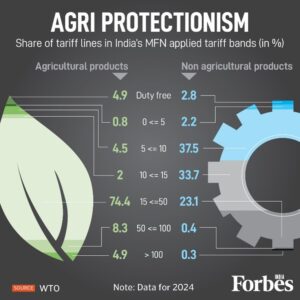
Agri vs Industry: India’s agricultural imports face a much steeper tariff curve than industrial goods. Over 8 percent of farm products attract tariffs between 50–100 percent, compared to just 0.4 percent for non-agri items. Here’s how India’s trade barriers stack up.
Proposed Reforms & Recommendations
- Rationalise tariff structure independent of US pressure:
- Cap duties: raw materials at 0-10%; non-sensitive goods 10-20%; sensitive goods 20-35%; luxury items 35-50%, no duty to exceed 50%.
- Use tariff rate quotas (TRQs) for sensitive agricultural goods to protect farmers while allowing some imports.
- Raise domestic productivity:
- Double agricultural R&D to at least 1% of agri-GDP.
- Focus on precision agriculture.
- Rationalise fertiliser subsidy via direct benefit transfer (DBT); free up fertiliser pricing.
- Strengthen value chains: enhance efficiency in post-harvest, logistics, “farm to fork” movement.
Key Trade-Offs & Justifications
- Agriculture protection is high due to large share of workforce (≈ 46%) in agriculture, small farm sizes (~1 hectare), food security concerns.
- But excessive protection hurts competitiveness, trade negotiations, invites retaliation.
- Imports can be part of growth strategy: comparative advantage, not just shield domestic producers
Test Your Knowledge 01
Q1. In the context of tariff policies, “tariff rate quotas (TRQs)” are best understood as:
(a) A system where tariffs are imposed only on luxury goods, not on essential goods.
(b) A mechanism that allows a specified quantity of a commodity to be imported at lower duty, with higher duty imposed on imports beyond that quantity.
(c) A WTO provision under which developed countries can unilaterally impose duties on agricultural imports.
(d) A subsidy scheme for exporters to neutralize the effect of import tariffs.
Hint :TRQs combine both quota and tariff features—lower duty up to a limit, higher duty beyond it.
TH Text & Context: How serious is the global plastic pollution crisis?
Syllabus: Pre/Mains – Environment
Why in News?
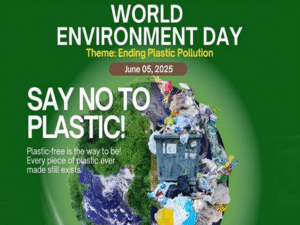
World Environment Day 2025 focused on “Ending Plastic Pollution”, highlighting urgent need for global action.
Scale of the Crisis
- Rising production & waste: Plastics doubled 2000–2019; 460 MT produced, 353 MT waste.
- Short lifespan: 2/3rd used <5 yrs; 40% packaging, 12% consumer goods, 11% textiles.
- Poor waste handling: 9% recycled, 19% incinerated, 50% landfilled, 22% unmanaged.
- Future risk: Waste may triple to 1.2 billion tonnes by 2060.
- Marine impact: 11 MT enter oceans yearly; 200 MT already present; plastics may exceed fish by mid-century.
Why It Matters?
- Non-biodegradable: Breaks into micro- & nano-plastics, contaminating soil, water, air.
- Health hazards: Enters food chain, drinking water, human bloodstream.
- Climate link: Plastics = 3.4% of global GHG emissions; may reach 19% of carbon budget by 2040.
- Ecosystem loss: Threat to biodiversity, fisheries, tourism, agriculture.
- Socio-economic cost: Impacts food security, livelihoods, public health expenditure.
Solutions Proposed
- Global treaty: UN resolution for legally binding pact to end plastic pollution.
- Production limits: Reduce virgin plastic, phase out single-use, promote alternatives.
- Waste management: Recycling innovations, profitable secondary plastic markets.
- Economic tools: Landfill/incineration taxes, deposit-refund, pay-as-you-throw, Extended Producer Responsibility.
- Design shift: Eco-friendly packaging, biodegradable materials, circular economy.
- Individual role: Reduce consumption, prefer reusables, support recycling.
- Awareness & media: Behaviour change, campaigns, nudging sustainable lifestyle.
Test Your Knowledge 02
Q2. With reference to global plastic pollution, consider the following:
- Plastics production has more than doubled between 2000 and 2019.
- Nearly half of global plastic waste generated is from clothing and textiles.
- Less than 10% of plastic waste is recycled worldwide.
Which of the above statements is/are correct?
(a) 1 only
(b) 2 and 3 only
(c) 1 and 3 only
(d) 1, 2 and 3
Hint: Production has surged since 2000 (true); packaging, not textiles, dominates waste (false); recycling rate is below 10% (true).
