
Kalam IAS Academy was founded by a team of committed individuals who believe that the traditional way of UPSC preparation needs to be changed.
TH Text & Context: Why was X’s ‘censorship’ challenge rejected?
Syllabus: Pre/Mains – Polity & Governance
Why in News?
Karnataka HC dismissed X Corp’s plea against Union govt’s Sahyog portal, upholding its legality for content takedown under Sec. 79(3)(b) IT Act.
Sahyog Portal: Function & Legal Basis
- Launched: Oct 2024 by MHA, run by I4C
- Centralised platform → takedown orders to ISPs, social media, web hosts
- Purpose → operationalise Sec. 79 safe harbour limits
- Safe harbour conditional → lost if unlawful content not removed post govt notice
- Case link → Shabana v. Govt of NCT Delhi (2024) revealed need for real-time coordination
X Corp’s Arguments
- Called Sahyog a “censorship portal”
- Govt using Sec. 79(3)(b) → bypass Sec. 69A safeguards
- Sec. 69A → due process: committee, hearing, reasoned order, judicial review
- Relied on Shreya Singhal v. UoI (2015) → SC upheld 69A as only valid framework
- Claimed parallel regime → arbitrary powers to thousands of officials
- Supported by DigiPub (92 news outlets) → disproportionate impact on journalism
Govt’s Defence
- Internet ≠ traditional media → faster virality → stricter oversight needed
- Safe harbour = statutory privilege, not right
- Sec. 79 ≠ censorship → only loss of immunity if non-compliant
- Sahyog = administrative tool, not blocking regime
- X lacks locus standi → Art. 19 applies only to citizens
- X complies abroad (e.g., US) but resists India
- 38 intermediaries (Google, Amazon, Microsoft, Telegram) already onboard
HC Ruling
- Petition “devoid of merit” → Sahyog = “instrument of public good”
- Article 19 rights only for citizens → X cannot claim
- India ≠ “playground” for platforms to evade accountability
- Entry into Indian market → privilege tied to responsibility
- X complies with US laws (Take It Down Act 2025) → hypocrisy in India
- Rejected claim Sahyog lacked legal basis → 2021 IT Rules = new framework, old precedents not applicable
Implications
- Expands govt control over online content → risk of broader censorship
- Criteria for “unlawful content” remain vague → selective enforcement risk
- May curb political accountability & critical reporting
- Enforcement inconsistency → not sustainable solution
- X plans appeal → possible larger HC Bench or SC review
- Conflict with Bombay HC 2023 ruling (struck down PIB fact-check unit for violating natural justice)
A brief into key legal provisions and rulings mentioned
⚖️ Section 79 IT Act, 2000 – Safe Harbour
- Shields intermediaries (social media, ISPs, web hosts) from liability for user content.
- ✦ Exemption lost if:
- They aid/abet unlawful activity, OR
- They fail to remove unlawful content after govt/court notice (Sec. 79(3)(b)).
⚖️ Section 69A IT Act, 2000 – Blocking Power
- Empowers Central Govt to block online content.
- Grounds → same as Art. 19(2) restrictions (sovereignty, security, public order, etc.).
- Procedural safeguards:
- Govt committee examines,
- Intermediary given hearing,
- Reasoned written order issued,
- Judicial review possible
⚖️ Shreya Singhal v. Union of India (2015)
- SC struck down Sec. 66A IT Act (vague & arbitrary).
- Upheld Sec. 69A as only valid framework for blocking, with safeguards.
- Clarified → takedown under Sec. 79(3)(b) valid only if based on court order/govt notification
Test Your Knowledge 01
Q1.With reference to the Sahyog portal recently upheld by the Karnataka High Court, consider the following statements:
- It is operated by the Ministry of Electronics and Information Technology.
- It enables real-time takedown orders under Section 79(3)(b) of the IT Act, 2000.
- Safe harbour protection is automatically available to intermediaries, irrespective of compliance with takedown notices.
Which of the above is/are correct?
(a) 1 only
(b) 2 only
(c) 1 and 3 only
(d) 2 and 3 only
Hint:
- Operator = MHA (I4C), not MeitY
- 79(3)(b) → real-time takedown notices
- Safe harbour = conditional, not automatic
IE Opinion: The Iran sanctions snapback: A diplomatic collapse and its wider consequences
Syllabus: Pre/Mains – International Relations
Why in News?
UN sanctions on Iran “snapped back” after UNSC rejected Russia-China resolution for delay → collapse of 30-day diplomacy window.
Trigger & Diplomatic Collapse
- Israel strikes (Fordow, Natanz, Isfahan) → US bombing → E3 push diplomacy
- E3 conditions → full IAEA inspections, 408.6 kg uranium accounting, talks w/ US
- Iran → uranium “trapped under ruins,” rejected US talks, limited IAEA gestures
- Aug 28 → E3 invoked UNSC 2231 snapback → countdown
- Russia-China tried 6-mo extension → failed (4–9–2 vote)
- Timing: avoided Oct (Russia UNSC presidency)
Sanctions Re-Imposed
- Nuclear & missile embargo → back in force
- Ban on conventional arms transfers → asset freeze, banking restrictions
- No explicit oil embargo, but US secondary sanctions → decisive
- UN call for financial vigilance → ↑ risk for banks/shippers
- Net effect: Washington tighter global enforcement grip
Impact on Iran
- Economy → ↑ crisis, inflation, social discontent
- Oil → China still main buyer, but tougher terms → Beijing ↑ leverage
- Politics → Pezeshkian: sanctions “unfair/illegal” (blames 2018 US JCPOA exit)
- Nuclear path risk → parallels w/ N Korea under “max pressure”
- Likely: suspend IAEA Cairo agreement, but not NPT exit (Moscow/Beijing constraint)
Geopolitical Dimensions
- Divide: West vs Russia–China–Iran axis
- Snapback strengthens rationale for future Israeli/US strikes
- Moscow-Beijing influence limited (failed UNSC resolution)
- Sanctions ripple effects beyond Iran → energy, shipping, global markets
India’s Stakes
- Oil: imports from Iran already stopped
- Chabahar Port (IPGL at Shahid Behesht Terminal) → vital for Afghanistan, Central Asia, bypassing Pakistan
- US waiver allowed continuity → now revoked under snapback
- Strategic dilemma: reconcile Eurasian connectivity w/ US pressure
Takeaway
- For Iran → deeper squeeze, possible nuclear hardening
- For West → tactical win, strategic uncertainty
- For Russia-China → limited leverage exposed
- For India → Chabahar connectivity at risk, strategy recalibration needed
Test Your Knowledge 02
Q2,With reference to the recent “snapback” of UN sanctions on Iran, consider the following statements:
- The snapback mechanism is provided under UNSC Resolution 2231 (2015), which endorsed the JCPOA.
- It allows any permanent member of the Security Council to veto the re-imposition of sanctions.
- Once invoked, it restores all prior UN sanctions without the need for a fresh UNSC vote.
Which of the above are correct?
(a) 1 and 2 only
(b) 2 and 3 only
(c) 1 and 3 only
(d) 1, 2 and 3
Hint: The mechanism under UNSC 2231 is automatic once invoked → no fresh vote, no veto possible.
TH Text & Context: The Wassenaar Arrangement: the need to reform export control regimes
Syllabus: Pre/Mains – International Relations
Why in News?
Microsoft Azure contracts with Israel sparked debate on gaps in Wassenaar Arrangement’s export controls in cloud era.

Wassenaar Arrangement: Basics
- Multilateral voluntary regime (1996) → 42 states → controls on conventional arms & dual-use tech
- Commitments → common control lists, info sharing, national discretion in licensing/enforcement
- Expansion 2013 → added “intrusion software” controls
- Limitation → designed for physical exports (devices, chips), weak for SaaS/cloud
Key Gaps
- Cloud services → info flows in grey zone, not always “export”
- SaaS model → remote use ≠ traditional export
- Consensus-based → 1 member can block reform
- Domestic laws differ → patchy enforcement, loopholes (e.g. defensive security research)
- Weak on human rights risk → focus remains WMD/military use
India’s Position
- Joined 2017 → aligned with SCOMET (export control framework)
- Role → more legitimacy seeking than pushing reform
- Current stance → little focus on cloud/surveillance risks
Reform Needs
- Scope expansion → include cloud infra, surveillance, biometric & cross-border data systems
- Export definition → treat API calls, remote admin rights, cloud access as exports
- End-use controls → license decisions based on specs + user identity, jurisdiction, oversight, HR risk
- Binding nature → treaty-level rules, peer review, denial mandates in atrocity-prone contexts
- Global coordination → shared watchlists, red alerts, technical interoperability standards
- Agility → technical secretariat, interim updates, sunset clauses, domain-specific regimes (AI, cyber weapons)
Challenges to Reform
- State resistance → innovation concerns, sovereignty, private industry lobbying
- Intricacy → mapping cloud to control categories, benign vs malign use, cross-border licensing
- Consensus hurdle → few holdouts can block changes
Emerging Pathways
- EU dual-use regulation → treats cloud service transmission as export
- UN Guiding Principles leverage → corporate HR duties + procurement rules as incentives
- U.S. EAR & EU rules → still draw legitimacy from WA lists
- Industry reference → Microsoft compliance cites WA, but SaaS realities expose major gaps.
Test Your Knowledge 03
Q3.With reference to the Wassenaar Arrangement, consider the following statements:
- It is a binding treaty under the United Nations Security Council aimed at controlling weapons of mass destruction.
- Its control lists include dual-use goods, conventional arms, and since 2013, certain categories of “intrusion software.”
- Decisions in the Arrangement are based on consensus among member states.
- India is a founding member of the Arrangement and incorporated its lists into SCOMET at the time of joining.
Which of the statements given above are correct?
(a) 2 and 3 only
(b) 1, 2 and 4 only
(c) 2, 3 and 4 only
(d) 1, 3 and 4 only
Hint: WA is voluntary (not binding, not UNSC, not WMD-specific) → India joined only in 2017 (not founding) → lists expanded in 2013 to intrusion software → decisions by consensus. ✅
IE Explained: India wins second mineral exploration contract in the Indian Ocean: What is this, why it matters
Syllabus: Pre/Mains – Geography & Environment
Why in News?
India signed 2nd ISA contract → exclusive rights for Polymetallic Sulphides (PMS) exploration in Carlsberg Ridge, Indian Ocean → 1st nation with 2 PMS contracts → largest PMS area allotted globally.
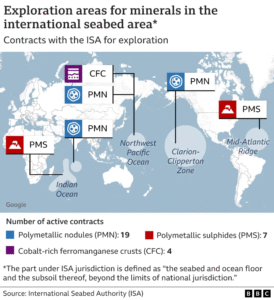
PMS & Its Importance
- Composition → Cu, Zn, Pb, Au, Ag + trace REEs/precious elements
- Uses → high-tech, RE, EVs, green tech
- India’s challenge → land reserves limited, import dependence ↑
- PMS origin → hydrothermal vents, deposition from mineral-rich hot gush
India’s PMS Journey
- 2016 → 1st ISA contract (Central & SW Indian Ridge)
- NCPOR lead agency → 3-phase exploration (survey → AUV/ROV mapping → resource eval)
- Deep Ocean Mission → infra boost (deep-sea vessels, AUVs, ROVs)
- Samudrayaan & “Matsya” vehicle → human-submersible support
Carlsberg Ridge Significance
- Location → Mid-ocean ridge b/w Indian & Somali plates (~2°N, closer to India)
- Geology → slow-spreading ridge (2.4–3.3 cm/yr), hydrothermal vent presence
- Strategic → nearer than earlier contracts (~26°S) → easier ops, ↑ security value
- Research base → 3 decades of Indian studies in region
PMS vs Other Underwater Minerals
- Terrain → hard, uneven, 2000–5000m depth (more complex than nodules/crusts)
- Tech needs → deep-sea vessels w/ dynamic positioning, precision nav & comms
- Tools → ship-mounted geophysics, AUVs, ROVs, advanced samplers & labs
- Multidisciplinary → geology, oceanography, biology, deep-sea tech
ISA Allocation Mechanism
- Legal base → UNCLOS framework
- Process → nation applies w/ work plan, env. baseline, tech/finance proofs
- Review → Legal & Technical Commission → ISA Council approval
- India’s edge → proven capability + earlier track record
Future Outlook
- India eyeing cobalt-rich ferromanganese crusts → Afanasy-Nikitin Seamount (CIO)
- Fits Govt. Blue Economy vision → strategic minerals + energy security
Test Your Knowledge 04
Q4.With reference to Polymetallic Sulphides (PMS) found on the ocean floor, consider the following statements:
- PMS deposits are typically associated with hydrothermal vents along mid-ocean ridges.
- They are rich in copper, zinc, and gold but do not contain rare earth elements.
- Exploration of PMS is less technologically challenging than exploration of polymetallic nodules due to their shallower occurrence.
Which of the above is/are correct?
(a) 1 only
(b) 1 and 2 only
(c) 2 and 3 only
(d) 1, 2 and 3
Hint:
- PMS → hydrothermal vents
- They do contain trace REEs
- PMS terrain harder & deeper (2000–5000m) → more challenging than nodules
IE Explained: Debate around assisted death: Should individuals have a right to die?
Syllabus: Pre/Mains – Ethics
Why in News?
Ruth Posner (96) and her husband chose assisted death in Switzerland, renewing ethical and legal debates on the right to die.

Ethical Arguments For Assisted Death
- Autonomy ✦ death as ultimate personal choice, free from external mediation
- Dignity in dying ✦ prevents prolonged existence without quality of life
- Relief from suffering ✦ compassion > prolongation of pain
- Consistency with refusal of treatment ✦ patients already allowed to refuse life-support → assisted death a logical extension
- Utilitarian benefit ✦ resource allocation to patients with better survival prospects
- Authenticity of agency ✦ surveys show elderly fear dependence > death itself
- Philosophical precedent ✦ Plato: those without health should be allowed to die
- Palliative care limits ✦ medicine cannot always eliminate pain or indignity
- Psychological peace ✦ option itself provides comfort even if not exercised
Ethical Arguments Against Assisted Death
- Autonomy paradox ✦ no autonomy once life ends → undermines argument
- Slippery slope ✦ criteria expand → from terminal illness → disability → depression
- Devaluation of life ✦ risks creating societal pressure on elderly/disabled to “choose” death
- Subjectivity of suffering ✦ no clear threshold → teenager with depression vs cancer patient
- Medical ethics ✦ violates Hippocratic oath “do no harm”
- Social coercion ✦ vulnerable groups (elderly, disabled, poor) may be subtly pushed toward death
- Normalisation risk ✦ joint suicides once tragic, now socially acceptable in some cultures
- Psychological distortion ✦ short-term despair may lead to irreversible decision
- Historical misuse ✦ Nazi eugenics (“lives not worth living”) used suffering as justification
- Alternative available ✦ ↑ palliative/hospice care can reduce suffering without ending life
Legal Frameworks
India
- SC 2018: “Right to die with dignity” part of Art. 21
- Permits passive euthanasia (withdrawing life-support) + living wills
- No active assisted dying (positive act causing death)
- Concerns: misuse by families, weak oversight, cultural resistance
UK
- Terminally Ill Adults (End of Life) Bill, 2024
- Age ≥18, terminal illness only, excludes disability/mental disorder
- Court approval mandatory, reflection periods, 12-month residency rule
Switzerland
- Liberal regime, no residency requirement → “death tourism”
- Physician must confirm patient acted autonomously, not for selfish motives
Other Models
- Netherlands, Belgium, Canada: broader access (incl. some psychiatric cases) but strict monitoring
- US (few states): physician-assisted suicide allowed under “Death with Dignity” laws
