
Kalam IAS Academy was founded by a team of committed individuals who believe that the traditional way of UPSC preparation needs to be changed.
IE Explained: Rahman-Dagar court case: A Hindu devotional art form and its Muslim custodians
Syllabus: Pre/Mains – History, Art & Culture
Why in News?
Delhi HC allowed AR Rahman’s appeal against ₹2 cr damages & credit change in copyright suit filed by Dhrupad exponent Ustad Faiyaz Wasifuddin Dagar (2023) over PS-2 song Veera Raja Veera.

Court Case & Verdict
- Allegation → Song copied Shiva Stuti (Jr. Dagar Brothers, 1978 Amsterdam recording).
- Plaintiff’s claim → Composition in raga Adana by Ustad Zahiruddin Dagar; diary notes as proof.
- HC ruling → Dagars = performers, not original authors; oral transmission = tradition; no copyright if in public domain.
- Rationale → Western music → written notation = authorship; Indian classical → oral legacy.
- Impact → Prevents performers from claiming authorship of inherited compositions.
Similarities & Dispute
- Shiva Stuti → finale in Dhrupad concerts, builds tempo, devotional climax.
- Veera Raja Veera → same melodic base, diff instrumentation.
- Music world attribution → Jr. Dagars credited (Gundecha Bros, Uday Bhawalkar, etc.).
- Issue → Composition vs Lyrics primacy; notations rarely written in Hindustani tradition.
Dhrupad: Form & Practice
- Meaning → “Structured”; oldest extant Hindustani form.
- Features → Rigid raga + tala; sung with rudra veena, pakhawaj, tanpura.
- Content → Bhakti poetry, Vedic hymns, devotional tone.
- Contrast → ↑ rigidity vs Khayal/Thumri; no taans, sargams, or erotic themes.
- Global status → Popular in Europe (deep listening practice), niche in India.
- 1960s Europe tours + recordings → Built Western following.
Dagar Lineage & Legacy
- Origin → Swami Haridas → Baba Gopal Das Pandey → converted to Islam under Mughals.
- Custodianship → Dagarvani style; blending Hindu devotion with Muslim practice.
- Mughal-era patrons → Courts of Alwar, Udaipur, Jaipur.
- Key figures →✦ Behram Khan → pioneer of Dagar gharana
✦ Allabande & Zakiruddin Khan → early masters
✦ Senior Dagar Brothers (Nasir Moinuddin & Aminuddin) → iconic duo
✦ Junior Dagar Brothers (Zahiruddin & Faiyazuddin) → creators of Shiva Stuti style - Unique syncretism → Muslim family preserving Vedic hymns, Saraswati worship.
Test Your Knowledge 01
Q.Dhrupad, recently in news, is correctly characterized by which of the following features?
- It emphasizes strict raga and tala structures with devotional content.
- It traditionally employs instruments such as rudra veena, pakhawaj, and tanpura.
- It allows taans and sargams as in Khayal.
- It gained significant global recognition through the European tours of the Dagar family in the 20th century.
Select the correct answer using the code below:
(a) 1 and 2 only
(b) 1, 2 and 4 only
(c) 2, 3 and 4 only
(d) 1, 3 and 4 only
Hint: Dhrupad is rigid (no taans/sargams), devotional, uses rudra veena–pakhawaj–tanpura, and was popularized in Europe by Dagar family tours.
IE Opinion: The case against counting Sentinelese groups for Census
Syllabus: Pre/Mains – Polity & Governance
Why in News?
Centre’s proposal for a “Non-Invasive Thermal Census” of Sentinelese sparks debate on ethics, legality, and tribal protection.
PVTGs & Census Context
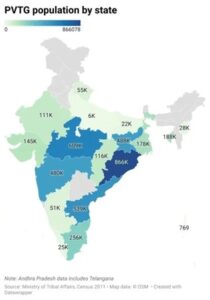
- 75 PVTGs across 18 States/UTs → 2.8M population (2011 Census undercounted).
- Identified by Dhebar Commission (1960s) → pre-agri tech, low literacy, ↓ population.
- Govt push (2027 Census) → accurate data for policy, constitutional duty, SDG monitoring.
Sentinelese Exception
- North Sentinel Island → ~100–150 ppl (uncontacted, hostile).
- ANPATR 1956 → The Andaman and Nicobar Islands (Protection of Aboriginal Tribes) Regulation, 1956 → buffer zone, zero-contact, legal ban on outsider entry.
- Not part of Scheduled Areas → special island-specific protection.
- Survival strategy → self-reliance, isolation, cultural continuity.
Risks of Enumeration
- Intrusion effects → noise, imaging, drones = breach of dignity/privacy.
- Historical trauma → Great Andamanese ↓ 5000 to ~50, Onges dependent.
- Case studies → 2018 Allen Chau killed, 2025 US citizen arrested.
- Colonial legacy → population loss, languages silenced, cultural disintegration.
Arguments Against Counting
- Cultural choice of isolation → core survival mechanism.
- “Counting = first step to intrusion” → leads to tourism, anthropological exploitation.
- PVTG protection ≠ homogenised → Andamanese need unique policy lens.
- Traditional knowledge resilience → 2004 Tsunami survival (read sea signs) vs modern tech failure.
- Census logic = state’s statistical compulsion; but here → act of violence on autonomy.
Pro-Enumeration View (Govt Rationale)
- “Non-contact” thermal tech → drones/infrared count without human intrusion.
- Useful for land mapping/wildlife census → extended to PVTGs.
- Data aids welfare targeting, monitoring schemes (SVAMITVA, nutrition, health).
Ethical & Policy Concerns
- Dignity vs statistics → worth of tribe not numerical, but cultural being.
- Pr otection priority > enumeration → survival threatened by mere exposure.
- Past lessons: intrusions irreversibly altered Andaman tribes.
- True welfare state → respect autonomy, enforce restraint, not curiosity.
Test Your Knowledge 02
Q. With reference to the Sentinelese tribe of Andaman & Nicobar Islands, consider the following statements:
- The Andaman and Nicobar Islands (Protection of Aboriginal Tribes) Regulation, 1956 (ANPATR) provides a legal buffer zone and prohibits outsider contact with the Sentinelese.
- The Sentinelese are recognised as a Particularly Vulnerable Tribal Group (PVTG) under the Dhebar Commission’s recommendations.
- Sentinelese are included within the Scheduled Areas of the Fifth Schedule for special protection.
Which of the statements given above is/are correct?
(a) 1 only
(b) 1 and 2 only
(c) 2 and 3 only
(d) 1, 2 and 3
Hint:
- ANPATR = Yes.
- Sentinelese = PVTG.
- Scheduled Areas ≠ apply in A&N.
Q. Consider the following tribes and their current status:
- Great Andamanese → Population drastically reduced from ~5000 to ~50.
- Onge → Dependent on external aid and welfare provisions.
- Sentinelese → Completely self-sustaining and uncontacted.
- Jarwa → Fully integrated with tourism and modern economy.
Which of the above are correctly matched regarding their present socio-cultural condition?
(a) 1, 2 and 3 only
(b) 1 and 4 only
(c) 2, 3 and 4 only
(d) 1, 2, 3 and 4
Hint
- Great Andamanese ↓, Onge dependent, Sentinelese isolated.
- Jarwa ≠ “fully integrated” (still semi-isolated).
IE Explained: How a new MGNREGA amendment pushes for spending on water conservation projects
Syllabus: Pre/Mains – Society & Social Issues
Why in News?
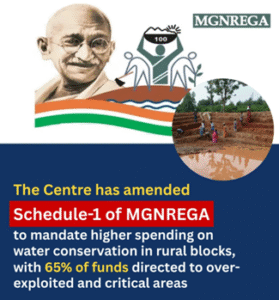
Centre amended Schedule-I of MGNREGA (Sep 23, 2025) → mandates minimum spending on water conservation & harvesting works at block level.
Key Provisions of MGNREGA
- 100 days guaranteed rural employment (on demand)
- Schedule-I → defines permissible public works
- Amendments via govt. notification (≈2 dozen so far)
- Earlier rule: 60% works (district level) → agri & allied assets (land, water, trees)
What Changed?
- New norm → block-level minimum allocation for water-related works
- Linked to CGWB groundwater categories:
- Over-exploited & Critical → ≥65%
- Semi-critical → ≥40%
- Safe → ≥30%
Rationale
- PM’s push → at Council of Ministers meeting, stressed on urgent water focus under NREGA
- Groundwater crisis → India among top global groundwater extractors (25% of world), >700 blocks in over-exploited stage
- Policy gap earlier → only district-level mandate, ignored micro-level water stress variation
- Block-level focus → ensures funds reach severely stressed zones first, avoids dilution by safer blocks
- Climate resilience → water conservation structures (ponds, recharge wells, check dams) → drought-proofing, recharge aquifers
- Rural livelihoods → water security supports agriculture, livestock, long-term productivity → beyond wage employment
Impact & Beneficiary States
- National picture: CGWB 2024 assessment (6,746 blocks):
- Over-exploited → >100% extraction: 751 (11.1%)
- Critical → 90–100%: 206 (3.0%)
- Semi-critical → 70–90%: 711 (10.5%)
- Safe → ≤70%: 4,951 (73.4%)
- Salinity: 127
- Funds earmarked: ~₹35,000 cr (of ₹86,000 cr NREGA FY26) → water-related works
- Major gainers (highest stressed blocks):
- Rajasthan → 214 (arid/semi-arid, severe depletion)
- Punjab → 115 (over-extraction due to rice-wheat cropping pattern)
- Tamil Nadu → 106 (dependence on groundwater, coastal stress)
- Haryana → 88 (intensive irrigation, falling water table)
- Uttar Pradesh → 59 (western UP esp. critical)
- Expected benefits:
- ↑ fund flow to water-scarce regions
- ↑ job creation via water asset works
- ↓ groundwater over-extraction trend
- ↑ irrigation sustainability for agriculture-dependent states
Test Your Knowledge 03
Q. With reference to the recent amendment to Schedule-I of the Mahatma Gandhi National Rural Employment Guarantee Act (MGNREGA), 2005, consider the following statements:
- The amendment mandates a minimum block-level expenditure on water conservation and harvesting works.
- The proportion of funds for water-related works varies depending on the groundwater categorisation by the Central Ground Water Board (CGWB).
- Previously, the Act required at least 60% of works at the Gram Panchayat level to be related to agriculture and allied activities.
Which of the statements given above is/are correct?
a) 1 and 2 only
b) 2 and 3 only
c) 1 and 3 only
d) 1, 2 and 3
Hint: Earlier mandate of 60% works was at district level, not Gram Panchayat level.
IE Explained: Gaza peace plan: Trump the businessman’s big imprint; for India, reasons for relief, caution
Syllabus: Pre/Mains – International Relations
Why in News?
US Prez Trump unveiled a 20-point “Comprehensive Plan to End Gaza Conflict”, seen as most ambitious bid since Oslo Accords.
Key Features of Trump’s Gaza Peace Plan
- Hamas disarmament & exit → Amnesty for those surrendering; safe passage to Jordan/Egypt/Qatar/Iran.
- Hostage-prisoner swap → 48 hostages (20 alive) to be freed; Israel to release 250 life-term convicts + 1700 detainees; 15:1 body-swap formula.
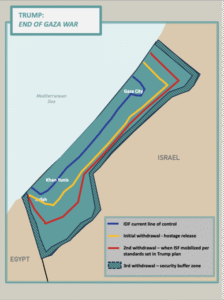
- International Stabilization Force (ISF) → US-Arab-Int’l backed; train Palestinian police; IDF phased withdrawal but buffer zone retained.
- Governance – “Day After Plan” → Technocratic Palestinian committee + Int’l experts; oversight by “Board of Peace” led by Trump; Tony Blair’s inclusion contentious.
- Aid & reconstruction → Water, power, hospitals, rubble clearance, bakeries; UN + Red Crescent to channel aid.
- Regional + Int’l guarantees → Compliance assured by Qatar, Jordan, UAE, Indonesia, Pakistan, Turkey, Saudi, Egypt; China & Russia welcome plan.
Implications:
For Trump
- Legacy boost → Oslo-like Nobel prize aspirations.
- Business footprint → Hotels, malls, real estate in “New Gaza”; Kushner’s Gulf links vital.
- Geopolitics → Iran excluded; weakened Hamas/Hezbollah gives US leverage.
For Israel
- Security assurance → Hamas disarmament, buffer zone
- Hostages returned → addresses strong domestic protests
- Risk → transitional governance may weaken Israeli leverage later
- Political gain for Netanyahu → Trump’s backing consolidates his position
For Hamas & Palestinians
- Hamas → existential risk; surrender/disarmament = loss of power base
- Amnesty/safe passage → limited option for cadre survival
- Palestinian Authority (PA) → gains legitimacy as partner in governance
- People → benefit via aid, reconstruction, public services revival
For Arab & Muslim States
- Collective role → Qatar, Saudi, UAE, Egypt, Turkey, Jordan, Indonesia, Pakistan endorse plan
- Prestige & mediation → enhances Arab centrality in peace process
- Economic stakes → participation in Gaza rebuilding, aid diplomacy
- Pakistan → profile ↑ in US-Arab diplomacy, possible leverage vs India
Implications for India
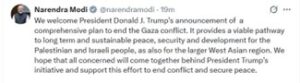
Positive
- Stability in region → diaspora safety (90 lakh Indians in W Asia, 18k in Israel).
- Energy security → 80% oil imports from ME; peace ↓ volatility in crude prices.
- Investment & trade → Boost to Arab FDI; IME-EC (India-ME-Europe corridor) viability ↑.
Concerns
- Pakistan role → Trump lauds Pak PM & Army Chief; ↑ US-Pak tilt.
- Strategic balance → Pak leverage in ME peace architecture; India cautious.
Test Your Knowledge 04
Q. In the context of conflict resolution in West Asia, which of the following past agreements can be considered relevant precedents to the Gaza Peace Plan 2025?
- Camp David Accords (1978)
- Oslo Accords (1993, 1995)
- Abraham Accords (2020)
- Taif Agreement (1989)
(a) 1 and 2 only
(b) 1, 2 and 3 only
(c) 2, 3 and 4 only
(d) 1, 2, 3 and 4
Hint:
- Camp David (1978) → Egypt–Israel peace.
- Oslo (1993/95) → Israel–Palestine, closest parallel.
- Abraham (2020) → Arab states–Israel normalization, US-brokered.
- Taif (1989) → Ended Lebanese Civil War → not directly Israel–Palestine but broader West Asia conflict resolution.
