
Kalam IAS Academy was founded by a team of committed individuals who believe that the traditional way of UPSC preparation needs to be changed.
TH Text & Context: Does India need nutritional transformation?
Syllabus: Pre/Mains – Society & Social Issues
Why in News?
→ India’s push from food security → nutritional security via functional foods + smart proteins amid sustainability demands.
Why India Needs Nutritional Transformation?
- Burden → >⅓ children stunted; adult protein intake ↑ but urban–rural divide persists.
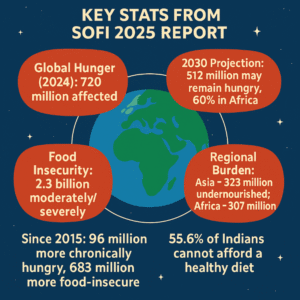
- Nutrition > calories → need proteins, vitamins, antioxidants → human capital, productivity gains.
- Sustainability → scale output without ↑ GHGs/water/land footprints; climate-resilient diets.
- Acceptance → scepticism of “lab-food”; taste/price parity + cultural fit needed.
- Regulatory vacuum → FSSAI lacks clear pathways for cultivated/precision-fermented foods (definitions, safety, labels).
- Quality claims → risk of mislabeling/greenwashing; weak post-market surveillance.
- Skills/infra → shortage in bioprocess, QA/QC, bioreactors, media; MSME access to shared facilities limited.
- Farmer linkages → limited contracts for protein crops/fermentation feedstocks; risk of value-chain exclusion.
- Market structure → possibility of concentration; IP/vendor lock-in for inputs.
India: Current Status (Policy, R&D, Market)
- Policy → BioE3 recognises functional foods & smart proteins; DBT–BIRAC grant windows active.
- R&D (functional) → bio-fortified staples: Zn-rice (IIRR, Hyd); Fe-pearl millet (ICRISAT).
- R&D (smart proteins) → CCMB cultivated-meat project ₹4.5 cr (DBT).
- Market (functional) → private lines by Tata Consumer, ITC, Marico (fortified staples/health SKUs).
- Market (smart proteins, 2023) → ~377 alt meat/egg/dairy SKUs by 70+ brands; startups: GoodDot, Blue Tribe, Evo.
- Size outlook (2030) → plant-based foods $85B (UBS) → $240B (Credit Suisse).
Way Forward
- Regulatory framework (India) → FSSAI novel foods code: clear definitions (plant/fermentation/cell-cultured), tiered safety (GRAS-like), allergenicity/tox, LCA-backed claims, front-of-pack labels, traceability & post-market surveillance.
- Coordination → MoHFW–MoFPI–DBT–DARE/ICAR–DST taskforce; single-window approvals; standards for DIAAS/PDCAAS protein quality.
- R&D & infra (PPP) → precision-fermentation & cell-culture pilot plants, shared downstream facilities, indigenous bioreactors/media; concessional finance + PLI-style incentives.
- Skilling & jobs → NSDC/ITI curricula: upstream/downstream bioprocess, GMP, regulatory; reskill dairy/meat workers; entrepreneurship for MSMEs.
- Farmer inclusion → contract farming for soy/pea/millets, supply lignocellulosic feedstocks, by-product valorisation; assured procurement (ICDS/Mid-Day Meals/hospitals) for fortified/alt-protein SKUs.
- Public trust & adoption → transparent safety data portals, third-party audits, chef-led taste trials, localisation of textures/spices; price-support for initial parity.
- Sustainability guardrails → mandatory LCA for claims, renewable energy in plants, water recycling, waste valorisation.
- Export & standards → align with Codex/EU novel food norms; testing labs accredited; branding India as “Sustainable Protein Hub.”
- Global case studies → lessons:
- Japan (1980s): functional foods framework → model for evidence-based claims & labels.
- Singapore (2020): first to approve cultivated chicken → emulate risk-proportionate, agile review.
- China: alt proteins in food-security strategy → integrate into India’s nutrition & innovation policies.
- EU – Farm to Fork: funding + standards for sustainable proteins → mirror via mission-mode programs.
Test Your Knowledge 01
Q. Smart proteins include which of the following?
- Plant-based proteins
- Fermentation-derived proteins
- Cultivated meat
Select the correct answer using the code below:
(a) 1 and 2 only
(b) 2 and 3 only
(c) 1 and 3 only
(d) 1, 2 and 3
Hint: Smart proteins span plant-based (restructured legumes/cereals), fermentation-derived (microbial/precision fermentation), and cultivated meat (animal cells grown in bioreactors). All three are included.
IE Explained: How Trump’s ‘G-2’ framing for US-China relations could impact allies
Syllabus: Pre/Mains – International Relations
Why in News?
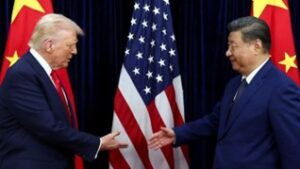
Trump’s “G-2” remark before meeting Xi Jinping (Busan, Oct 2025) signals US recognition of China as equal power → raises concern among allies (India, Japan, Australia) over US policy shift in Indo-Pacific.
Concept of G-2
- Origin → Coined (2005) by C. Fred Bergsten (Peterson Institute) in The United States and the World Economy.
- Purpose → Strengthen US ties with key powers (EU, China, Japan, Saudi Arabia) → coordinate macroeconomic & global issues.
- Role Post-2008 Crisis → US–China cooperation vital for global recovery & climate compact (Bergsten, Foreign Affairs).
- Expert Support → Brzezinski & Niall Ferguson backed concept; Obama–Hu Jintao diplomacy hinted similar approach.
- China’s Rise Since → Under Xi (2013→) assertive power projection → BRI expansion, SCS militarisation, tech nationalism.
- US Shift Under Trump 1.0 → 2017 NSS labelled China “strategic rival” → revival of Quad (India–Japan–Australia–US) to balance Beijing.
Implications for Allies & Global Balance
- Trump’s New Framing → G-2 = parity signal → potential dilution of Quad & FOIP vision.
- India → Tariffs ↑ to 50% → Quad summit deferred → talks of “new Quad” (Philippines inclusion) → yet India’s size & role make exclusion unrealistic.
- Japan & Australia → Concern over US reliability → G-2 focus may undercut collective deterrence vs China.
- ASEAN & Others → Fear of reduced US engagement → space for China ↑ via RCEP, BRI.
- Systemic Impact → G-2 framing → pushes bipolarity (US–China) ↓ multipolar cooperation (G20, Quad, BRICS).
- India’s Diplomatic Course → Maintain strategic autonomy → deepen Quad+, EU, ASEAN, Global South partnerships.
- Possible Scenario → If Trump–Xi bonhomie fades (like Trump–Putin), allies may regain leverage & cohesion.
Test Your Knowledge 02
Q. In the present geopolitical context (2025), the term “G-2” signifies:
(a) A revived strategic partnership projecting parity between the US and China in global power hierarchy
(b) A new economic forum replacing the G-20 with emerging economies
(c) A joint military command mechanism for Indo-Pacific security
(d) A diplomatic initiative under the Quad to counter Chinese influence
Hint: Trump’s 2025 “G-2” framing → acknowledges China as near-equal global power → raises concern among US allies (India, Japan, Australia) over dilution of anti-China coordination in Indo-Pacific
TH Science: Aditya-L1 gets a close look at eruptions from the sun
Syllabus: Pre/Mains – Science & Tech
Why in News?
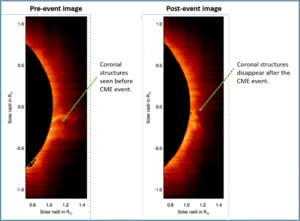
Aditya-L1’s Visible Emission Line Coronagraph (VELC) captures world’s 1st visible-wavelength spectroscopic data of a Coronal Mass Ejection (CME) — closest-ever to Sun’s surface.
☀️ Aditya-L1 Mission Snapshot
- Launch → 2 Sept 2023 (PSLV-C57) from Sriharikota
- India’s 1st solar observatory → placed at Sun–Earth L1 (1.5 mn km)
- Lead → ISRO; Core payload → VELC (by Indian Institute of Astrophysics)
- Intl. collaboration → IIA + NASA scientists
- Continuous 24×7 solar observation → “sun never sets” at L1 point
- Aim → study solar corona, solar wind, CMEs, magnetic storms
🔭 Breakthrough Discovery
- 1st spectroscopic CME observation in visible range (not just imaging)
- Observed very near solar surface → unprecedented proximity data
- Enables direct measurement of CME birth parameters
- Confirms instrument sensitivity & calibration of VELC
📊 CME Parameters (Measured by VELC)
- Electron density → ≈370 mn/cm³ (vs 10–100 mn/cm³ in normal corona)
- Mass → ≈270 mn tons (≃180× Titanic iceberg)
- Energy → 9.4 × 10²¹ J
- Temperature → 1.8 mn K
- Speed → 264 km/s (initial velocity)
- Location → Close to Sun’s visible limb (coronal base)
- Observation timing → near onset of ejection (few minutes after lift-off)
🔬 Scientific Insights
- 1st quantitative spectral data of CME → visible emission lines (Fe XIV, Fe X)
- Enables estimation of plasma parameters → density, velocity, temperature
- Near-Sun data crucial → CME evolution, shock formation, particle acceleration
- Helps compute mass & energy loss rate of Sun per CME
- Enhances space weather forecasting accuracy
- Supports coronal heating & magnetic reconnection studies
🌍 Broader Implications
- CMEs → major drivers of geomagnetic storms, auroras, satellite disruptions
- Early CME detection → better space-weather alerts for Earth & satellites
- Strengthens India’s role in heliophysics & global solar monitoring network
- Complements NASA’s Parker Solar Probe & ESA’s Solar Orbiter missions
🔆 Future Outlook
- Sun nearing Solar Cycle 25 peak → ↑ CME frequency (2024–26)
- VELC fully operational → continuous CME database expected
- Multiple future observations → refine CME initiation & propagation models
- Foundation for Aditya-L2 or advanced solar missions from India.
Test Your Knowledge 03
Q. Recently, scientists reported the first spectroscopic observation of a Coronal Mass Ejection (CME) near the Sun.
Which of the following parameters can be determined from such spectroscopic data?
- Electron density
- Temperature
- CME mass and velocity
- Sun’s internal nuclear fusion rate
Select the correct answer using the code below:
(a) 1 and 2 only
(b) 1, 2 and 3 only
(c) 2, 3 and 4 only
(d) 1, 3 and 4 only
Hint: Spectroscopy yields CME density, temperature, speed, mass; not internal fusion rate.
IE Explained: Why Indian science fails to produce Nobel laureates
Syllabus: Pre/Mains – Science & Tech
Why in News?
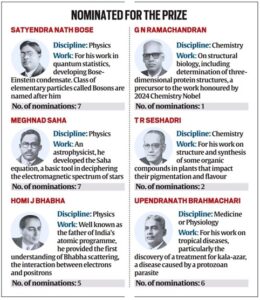
India hasn’t produced a science Nobel laureate in 94 years → exposes deep flaws in academic leadership, hiring, and research culture.
Historical Context & Global Comparison
- C.V. Raman (1930) → only Indian citizen Nobel in science.
- Indians abroad → Khorana (1968), Chandrasekhar (1983), Ramakrishnan (2009).
- 94-yr drought vs. China (5 laureates since 1957), Japan (20+ laureates).
- India’s R&D spend ~0.7% of GDP vs. US (2.8%), China (2.4%), Korea (4.9%).
- Global Innovation Index 2024 → Rank 40, below smaller economies like Estonia, Portugal.
Core Problem → Resistant & Bureaucratic Academia
- Leadership crisis → control > creativity; few “builders” since Bhabha–Sarabhai era.
- Admin-heavy institutes → directors act as bureaucrats, not scientists.
- Funding growth (₹1.25 lakh cr, 2024–25) ≠ output growth → research inertia persists.
- Example: ISRO, TIFR excel due to visionary autonomy, unlike most CSIR/IIT labs.
- Seniority-based promotions → demotivates young innovators.
Flawed Hiring, Patronage & Institutional Politics
- Opaque recruitment → network, region, language bias > merit.
- 40% of PhDs (DST 2023) → no permanent academic position.
- Average age of faculty recruit: 37–40 yrs → global avg ~31 yrs.
- Young researchers fight for lab space, grants, PhD students; 3–5 yrs setup delay.
- Case: IISc postdocs leaving → lack of tenure-track pathway.
- Brain drain ↑ → 1.6 lakh Indian-origin researchers abroad (UNESCO 2023).
- Institutions reward loyalty > performance, blocking fresh ideas.
Distorted Research Culture → Quantity > Quality
- Output obsession → number of papers, not originality.
- India 5th in publication volume but <1% among top 1% cited (Scimago 2023).
- 200+ medals/fellowships yearly → awards inflation, diluted prestige.
- Example: CSIR labs publish prolifically but few global patents or high-impact breakthroughs.
- Citation race → discourages long-term, risky, interdisciplinary research.
- No India-based institution in Nature Index Asia-Pacific Top 50 (2024).
- Fear of failure + committee culture → kills innovation appetite.
Leadership Reform → Empower “Gen Z” Scientists
- Average leadership age >60 yrs; reform needs 40–50 yrs cohort in top roles.
- “Gen Z” scientists → globally trained, patent filings ↑ 40% (2010–24).
- Leadership rotation every 5 yrs → ensure accountability & dynamism.
- Half of key posts (DST, DBT, CSIR, VCs, PSA office) → open to younger achievers.
- Past model → Bhabha–Sarabhai’s youth-led transformation post-1947.
- Visionary leadership, not administrative control, builds discovery culture.
The Way Forward
- Raise R&D investment → 3% of GDP (OECD avg 2.7%).
- Make hiring, funding & evaluation transparent; use global peer-review (NSF, ERC model).
- National Research Foundation (NRF 2024) → align basic & applied science goals.
- Strengthen startup-research linkages (AIM, NIDHI, i-STEM).
- Incentivize collaborative, interdisciplinary, high-risk projects.
- Reward mentorship, societal impact, and innovation, not seniority.
- Reform academies → reduce ceremonial awards, increase accountability metrics..
Test Your Knowledge 04
Q. Which of the following statements is/are correct regarding India’s innovation ecosystem?
- India ranks among the top 50 nations in the Global Innovation Index.
- India’s startup ecosystem is among the top 3 globally in terms of volume.
- India’s patent-to-publication ratio is higher than the global average.
Select the correct answer:
a) 1 and 2 only
b) 2 and 3 only
c) 1 and 3 only
d) 1 only
Hint: Patent-to-publication ratio remains below global average.
TH News: Climate change, imbalance in fertilizer use impacts soil’s organic carbon: ICAR study
Syllabus: Pre/Mains – Environment
Why in News?
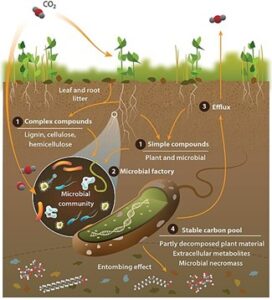
→ ICAR 6-yr study links climate change + fertiliser imbalance → major ↓ in soil organic carbon (SOC) across India’s farmlands.
Key Study Insights
- Scale & Scope → 2.54 lakh soil samples → 620 districts → 29 States → 20 agro-ecological regions.
- Institutions → ICAR–IISS (Bhopal), 8 scientists incl. DG M.L. Jat.
- Duration & Output → 2017–23 study → published in Land Degradation & Development (UK).
- Tool → ‘Agri-ecological base map’ → SOC impact by crop & fertiliser use.
Drivers of SOC Depletion
- Fertiliser imbalance → Excess urea + P use (Haryana, Punjab, W-UP) → ↓ SOC >20%; balanced mix (Bihar) → SOC stable.
- Climate change → Each 1 °C ↑ temp → ~3–5% SOC loss (past FAO data).
- Elevation → ↑ altitude (hills > 800 m) → SOC > 1%; lowlands < 0.4%.
- Cropping systems → Rice/pulse → ↑ microbial C sequestration; wheat/coarse grains → ↓ SOC.
- Land use → Arable > barren SOC difference > 2×; barren lands rapid C loss.
Correlations & Impacts
- SOC ↔ Micronutrients → Low SOC → Zn, Fe, Mn deficiency ↑ (>50% samples deficient).
- SOC ↔ Temperature → Negative corr ( R ≈ –0.7 ); Rajasthan & Telangana low SOC < 0.3%.
- SOC ↔ Elevation/Rainfall → High rain & altitude zones (NE India, W Ghats) → SOC ↑ > 1%.
- SOC ↔ Soil Health → ↓ SOC → ↓ microbial biomass → ↓ fertility → ↓ yield (10–15%).
- SOC ↔ Climate feedback → ↓ SOC → ↑ CO₂ emission → GHG loop ↑.
- SOC ↔ Heat balance → Low SOC → ↑ albedo → ↑ ground heat reflection.
- SOC ↔ Food security → Poor soil health → nutrient imbalance → yield instability.
- SOC ↔ Economy → ↓ SOC → ↓ C credit potential (India’s C market ≈ $1.3 bn lost potential/yr).
- SOC ↔ Environment → Soil C loss = CO₂ flux ↑ → accelerates climate warming.
Policy Recommendations
- Soil cover & plantations → All-season vegetation → ↑ C capture + reduce erosion.
- Low-C soils (<0.25%) → Targeted organic manure + irrigation support.
- Carbon credit incentives → Reward farmers for ↑ SOC (1 t C = 3.67 t CO₂ sequestered).
- Climate-smart cropping → Adopt rice-pulse-legume rotations for C gain.
- Balanced fertilisation → Integrated nutrient management (INM) promotion.
- SOC map usage → Guide land degradation programmes & C-credit assessment.
Test Your Knowledge 05
Q. Consider the following statements about Soil Organic Carbon (SOC):
- SOC improves soil fertility by enhancing microbial activity and micronutrient availability.
- SOC decreases with increase in temperature and increases with higher elevation.
- SOC is a major determinant of soil albedo and ground heat reflection.
Which of the statements given above are correct?
(a) 1 and 2 only
(b) 2 and 3 only
(c) 1, 2 and 3
(d) 1 only
Hint: ↑ SOC → ↑ microbes & nutrients; ↓ with heat, ↑ with altitude; low SOC → ↑ heat reflection (↑ albedo).
IE Explained: India withdraws from Ayni airbase: What is it, how does this impact the country?
Syllabus: Pre/Mains – Security
Why in News?
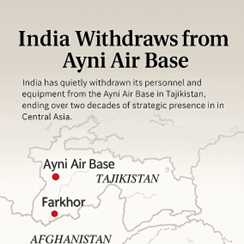
→ India has withdrawn from Ayni Airbase (Tajikistan) — its only full-fledged overseas base, ending a 20-year strategic presence in Central Asia that offered leverage over Pakistan & proximity to China’s Xinjiang.
Ayni Airbase – Overview & Significance
- Location → 20 km from Afghanistan’s Wakhan Corridor → borders PoK & Xinjiang (China)
- Built & Upgraded → Soviet-era base → refurbished by India (↑ $80 mn) under 2002 Indo-Tajik pact
- Infrastructure → 3,200 m runway + hangars + fuel depots + ATC (by BRO) → capable for Sukhoi-30MKI, heavy lift aircraft
- Deployment → ~200 Indian Army & IAF personnel stationed
- Operational Use → Support to Northern Alliance (anti-Taliban) + 2021 Kabul evacuation
- Strategic Value → Only Indian base in Central Asia → proximity to PoK, Xinjiang & Afghan theatre → enhanced surveillance & quick-response capacity
- Symbolic Significance → Demonstrated India’s regional reach & intent to project power beyond South Asia
Withdrawal – Reasons
- Bilateral Pact Expiry (2002–2022) → Agreement for rehabilitation & operation concluded; base handed to Tajikistan
- Lease Non-renewal → Dushanbe reportedly under Russian & Chinese pressure → resisted extension
- Quiet Exit → Personnel & equipment withdrawn in 2022 → information surfaced publicly in 2025
- Official Stand → India: “Facility handed after agreement conclusion” → no mention of strategic tensions
Implications for India
- ↓ Strategic Presence → No longer any operational base in Central Asia
- Loss of Foothold → Reduced ability to monitor Xinjiang–Wakhan–PoK corridor
- Regional Vacuum → ↑ Russian & Chinese dominance; reports of potential PLA presence in Tajikistan
- Setback to Extended Neighbourhood Policy → limits India’s land-based engagement with CARs
- Security & Intelligence Gap → weaker early-warning/rapid-deployment capabilities in North-West frontier
- Pivot to Maritime Strategy → ↑ importance of Agaléga (Mauritius), Andaman, & IOR surveillance chain
- Future Outlook → Need for renewed Central Asia outreach via diplomacy, logistics access, joint exercises & energy cooperation.
Test Your Knowledge 06
Q. Ayni Airbase, recently in news, is located in which of the following countries?
(a) Uzbekistan
(b) Tajikistan
(c) Turkmenistan
(d) Kyrgyzstan
