
Kalam IAS Academy was founded by a team of committed individuals who believe that the traditional way of UPSC preparation needs to be changed.

IE Explained: How Vivekananda introduced America to Hinduism
Syllabus: Pre/Mains – History, Ethics
Why in News?
Vivekananda’s 1893 speech in Chicago is being commemorated as a milestone in India-America religious/intellectual exchange.

Context & Arrival in America
- Arrived USA in 1893 to represent India at the Parliament of World’s Religions.
- At that time Western audience had some interest in Eastern philosophy (Transcendentalism, Dar-winism, biblical criticism, etc.), so fertile ground.
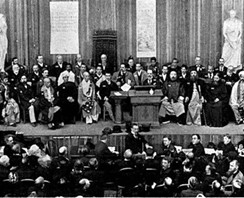
Key Speech at Parliament, Chicago (11 Sept 1893)
- Salutation “Sisters and Brothers of America” (unusual, warm, drew applause).
- Emphasis on religious tolerance: “accept all religions as true”; end fanaticism/separatism.
- Presented Vedānta (Advaita) as inclusive, universal, non-dual philosophy.
After-Effects & Legacy in America
- Toured USA for ~2 years lecturing widely; visited universities such as Harvard.
- Founded the first Vedanta Society in New York (1894); later others (e.g. San Francisco) established.
- Popularised yoga, meditation, Eastern spirituality among both intellectuals and general public.
Significance & Broader Impact
- Opened Western awareness to Hinduism not merely as exotic ritualistic religion but philosophical, ethical, spiritual system.
- Enabled inter-faith dialogue; catalysed Vedānta societies in America which persist today.
- Influence on Western thinkers, culture; shaped how India’s spiritual philosophies were received globally.
Test Your Knowledge 01
Q1. The Parliament of the World’s Religions (1893) is significant in world history because:
- It provided a global platform for Eastern philosophies amidst Western intellectual crisis.
- It was the first attempt at organised inter-faith dialogue at an international scale.
- It was convened by the United Nations in Chicago to promote religious tolerance.
Which of the above is/are correct?
(a) 1 and 2 only
(b) 2 only
(c) 3 only
(d) 1, 2 and 3
Hint : The 1893 Chicago meeting is recognised as the first formal/global inter-faith gathering and launched Eastern religions (Vivekananda) onto the world stage — the UN didn’t exist then.
TH Text & Context: Why are European nations now moving to recognise Palestine?
Syllabus: Pre/Mains – International Relations
Why in News?
France plans to recognise Palestine in September 2025 at UN General Assembly.Several smaller / mid-sized European countries (Spain, Ireland, Norway, Slovenia, Malta) already recognised Palestine or moving to do so.
Key drivers pushing European states to move faster
- Humanitarian crisis in Gaza after October 7 attacks, with large scale destruction and civilian suffering.
- Strong pressure from domestic public opinion: protests, youth movements, civil society demanding action.
- Legal and moral consistency: comparisons with Ukraine war, international law arguments (occupation, war crimes, humanitarian law).
- Diplomatic initiative & leadership (France, Saudi Arabia organising conferences pushing recognition).
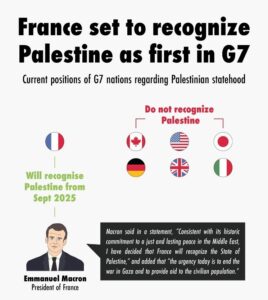
Variations & cautions between countries
- Some countries (Germany, UK, etc.) are supportive of a two-state solution but hesitate to recognise formally yet; waiting for “useful moment” or for Israeli actions (ceasefire, better humanitarian access).
- Concerns over security, diplomatic backlash (from Israel, U.S.), and domestic political costs.
Can the EU coordinate a unified response?
- EU Common Foreign & Security Policy demands unanimity for a collective foreign policy decision like recognition. Hard to get all 27 members in agreement.
- There is increasing pressure within EU institutions: proposals for sanctions, suspending parts of association agreements with Israel, freezing funds.
- But deep divisions persist among member states on how far and fast to go. Some fear diplomatic fallout; some are more cautious.
- “Like-minded coalitions” (smaller group of EU states acting together) are emerging as an interim approach.
Likely outcomes & implications
- Formal recognition by additional EU members at UN General Assembly under conditional criteria (e.g. humanitarian access, ceasefire).
- EU might adopt limited collective measures (sanctions, trade or funding suspensions, donor group for Gaza) rather than unified recognition.
- Shifting credibility stakes: EU’s global image & consistency in applying international law are increasingly seen as tied to its stance.
Test Your Knowledge 02
Q2. The term “Consistency Gap,” often used in recent debates refers to:
(a) Disparity in trade benefits offered to Palestine compared to Israel under EU agreements
(b) Inconsistency in EU’s application of international law between the Ukraine conflict and Israeli occupation of Palestinian territories
(c) Gap in humanitarian aid commitments and actual delivery by EU countries to Gaza
(d) Difference between recognition of Palestine by Eastern and Western European states
Hint: “Consistency gap” is used to criticise inconsistency/double-standards in EU responses — notably between its posture on Ukraine vs its stance on Israel/Palestine.
Q3. Recently, France announced readiness to recognise Palestine but “only at a useful moment.” Recognition of states in international law is primarily based on which of the following doctrines?
(a) Doctrine of Lapse
(b) Montevideo Convention criteria
(c) Helsinki Accords principles
(d) Hague Convention on Recognition of States
Hint: State recognition generally rests on the Montevideo test — permanent population, defined territory, government, capacity for international relations.
IE Explained: Scientists uncover hidden freshwater under sea floor: What are offshore aquifers and why are they significant?
Syllabus: Pre/Mains – Geography
Why in News?
Expedition 501 has confirmed a massive freshwater aquifer beneath the sea-floor off the U.S. northeast coast, from New Jersey → Maine, via drilling ~1,289 ft below sea floor, collecting ~50,000 litres of water.
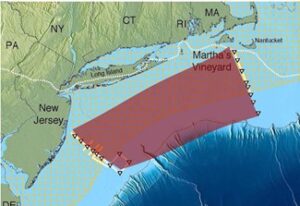
What are Offshore Aquifers & Key Findings?
- Bodies of porous rock/sediment beneath the sea floor holding fresh or “freshened” water unlike typical saline seawater.
- Extent: up to ~30-50 km off the coast in this case; depths ~400 m below seabed.
- Salinity: some water samples very low salt (≈1 parts per thousand), some slightly higher but still far fresher than sea (~35‰).
How Freshwater Might Get There (Origins)?
- Past ice ages: sea levels were lower, lands now submerged were dry → rain or meltwater infiltrated sediments; glacial weight pushed water into offshore porous zones.
- Connection with onshore aquifers: possibility of subsurface flow from land to offshore sediments.
- Isolation via cap rock or clay layers: compacted sediment-layers prevent mixing with overlying salt water, preserving fresher water.
Why They Matter (Significance)?
- Potential untapped freshwater reserves to help combat water scarcity, especially in coastal / drought-prone regions.
- Could supply large urban centres for long periods if sustainable (e.g. enough water for New York City “for centuries” in this case).
- Offers resilience: as land aquifers degrade (due to saltwater intrusion, overuse), offshore aquifers might provide alternatives.
Challenges & Unknowns
- Renewable vs finite: need to establish age, recharge rate of water; if ancient (“fossil”) water, extraction must be careful or minimal.
- Technical & financial costs: drilling undersea, designing wells, avoiding saltwater contamination, transporting water onshore; expensive project (≈ US$25 million) just to explore.
- Environmental/ecological risks: disturbance of marine ecosystems; possible unintended flows or loss of nutrients; impact on adjoining coastal groundwater.
- Governance & legal issues: rights over undersea water, community involvement, regulation, ownership.
Test Your Knowledge 03
Q4. Consider the following statements regarding offshore aquifers:
- They are located beneath the sea floor and contain freshwater in porous sediments or rocks.
- They are primarily recharged by direct rainfall over the ocean surface.
- Offshore aquifers may contain more freshwater than all water withdrawn so far from land aquifers.
- Clay-rich cap rock prevents mixing of freshwater with saline water.
Which of the statements given above are correct?
(a) 1 and 2 only
(b) 1, 3 and 4 only
(c) 2 and 3 only
(d) 1, 2, 3 and 4
Hint: Offshore aquifers are fresh water in porous sediments under the seafloor (1); recharge is mainly from land/palaeo-recharge (not direct ocean rainfall) so (2) is false; they may hold vast freshwater volumes (3) and are often capped by clay layers that limit mixing (4)
TH Text & Context: Can vultures help prevent pandemics?
Syllabus: Pre/Mains – Environment
Why in News?
India’s vulture populations collapsed (~95%) since 1990s due to veterinary use of diclofenac; new research shows this collapse raised human mortality and pandemic spillover risk.
Role of Vultures in Disease Prevention
- Efficient removal of carcasses → reduces decay, pathogen growth.
- Limits alternative scavengers (dogs, rats) that spread zoonoses (e.g. rabies).
- Prevents water contamination and microbial spread from decomposing animal remains.
Key Facts
- In India in the early 1980s, ~40 million vultures; by 2000s collapsed by over 95%.
- Diclofenac introduced veterinary use in 1990s; caused kidney failure in vultures feeding on treated livestock.
- After bans on diclofenac, vulture decline has slowed; some recovery observed.
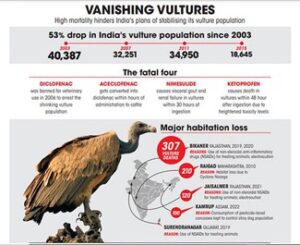
Consequences of Vulture Decline for Public Health
- Human deaths ↑ ~4-5% in districts where vultures declined most heavily.
- Estimate: ~100,000 extra deaths per year between 2000-2005 attributable to vulture loss.
- Rise in feral dog population → more dog bites, more rabies cases.
- Economic damages large:g. ~$70 billion/year in mortality costs.
Why Protecting Vultures Is Cheaper Than Fighting Outbreaks?
- Prevention via vulture conservation avoids the high costs of medical treatment, outbreak containment.
- Small investments (bans on harmful drugs, breeding centres, safe carcass disposal) yield large returns in lives saved and reduced disease burden.
- Natural scavengers are free, always present; replacing them (dog vaccination, carcass removal infrastructure, etc.) is costly and slower.
What India & Communities Can Do / Are Doing?
- Ban veterinary use of diclofenac; promote safer alternatives (e.g. meloxicam).
- Breeding & reintroduction programmes (e.g. Jatayu Conservation Breeding Centre).
- Mapping vulture habitat / carcass dump spots; integrating into One Health strategies.
- Engaging local communities as stewards: carcass reporting, monitoring, awareness.
Test Your Knowledge 04
Q5. Consider the following migratory routes of birds:
- East Asian–Australasian Flyway
- Central Asian Flyway
- East Atlantic Flyway
Vultures in India are part of which of the above?
(a) 1 only
(b) 2 only
(c) 1 and 3 only
(d) 2 and 3 only
Hint: India lies mainly in the Central Asian Flyway; most Indian vulture species are resident or move locally rather than following the East Asian-Australasian or East Atlantic flyways.
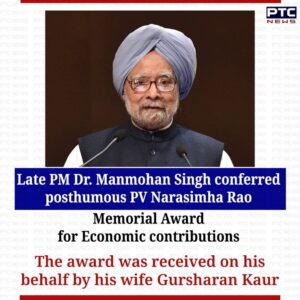
Former PM Manmohan Singh posthumously honoured with P V Narasimha Rao Memorial Award
Why in News?
Former PM Dr Manmohan Singh has been posthumously conferred the P V Narasimha Rao Memorial Award for Economics.
Key Details
- The Hyderabad-based P V Narasimha Rao Memorial Foundation (PVNMF) instituted the award to recognise outstanding contributions in economics and nation-building.
- The citation lauds Singh’s pivotal role in the 1991 economic reforms that set India on a higher growth trajectory.
- His wife Gursharan Kaur accepted the honour in New Delhi, where it was presented by former Planning Commission Deputy Chairman Montek Singh Ahluwalia.
