
Kalam IAS Academy was founded by a team of committed individuals who believe that the traditional way of UPSC preparation needs to be changed.

IE Explained: Story of World War II Battle of Imphal, mentioned by Modi in Manipur
Syllabus: Pre/Mains – History
Why in News?
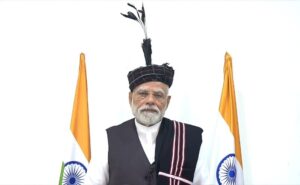
PM Modi in Manipur (Sept 13, 2025) recalled Netaji’s words calling Manipur “door to India’s freedom”, linking to WWII Battles of Imphal & Kohima.
Background: WWII & India
- WWII reached India: Andaman & Nicobar (Japanese occupation, 1942–45), Northeast (Imphal-Kohima battles, 1944)
- India: logistics hub, manpower, resources, finance for Allies
- Indian Army crucial in both World Wars
Strategic Importance of Imphal
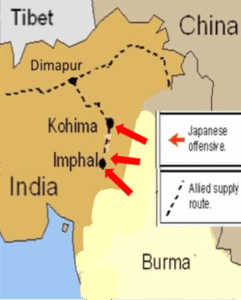
- Imphal plain: only major flat ground between Burma & India
- Staging base for Allied Burma campaign, supply hub for China (Chiang Kai-shek)
- Dimapur–Imphal road: lifeline for supplies
- Airfields critical for Allied logistics
Japanese Offensive, 1944
- Japanese 15th Army launched March 1944 invasion of Northeast
- Two-pronged thrust: Imphal (main objective), Kohima (cut Dimapur–Imphal road)
- Goal: isolate Imphal, disrupt China supply, gain India foothold
Role of INA
- 6,000 INA troops with Japanese 15th Army
- Bose’s vision: INA “vanguard” of Indian liberation
- Hoped dual pressure (inside + outside India) would collapse British rule
- INA participation militarily limited, symbolically powerful
The Battles
Kohima (Apr–Jun 1944)
- Phase 1: 1,500 Allied troops held ridge vs 15,000 Japanese
- Phase 2: Allied reinforcements, tanks cleared Japanese
- Fierce fighting: “tennis court” battle, hand-to-hand combat
Imphal (Mar–Jul 1944)
- Japanese encircled valley by April
- Continuous assaults on “spokes of wheel” (roads into Imphal)
- Slim’s defence: mobility, logistics, Allied air superiority
Outcome & Significance
- Japanese 15th Army: 85,000 troops → 53,000 casualties (combat, starvation, disease)
- Allied casualties: ~12,500 (Imphal), ~4,000 (Kohima)
- Turning point: halted Japanese advance into India, secured Burma recapture
- Netaji, INA retreated to Burma–Singapore, later collapse after Japan’s surrender
- Bose died Aug 1945 (plane crash, 3 days after Hiroshima-Nagasaki)
Legacy
- Battles ranked among fiercest WWII land battles
- Seen as Japan’s greatest defeat, “Stalingrad of the East”
- Locals (Nagas, Meiteis, Kukis) fought and suffered on both sides
- Under-remembered in West, complex in Indian historiography (INA vs British Indian Army)
- Critical in ensuring Allied victory in Asia, blocking Japanese imperial ambitions
Test Your Knowledge 01
Q1. Why are the Battles of Imphal and Kohima considered turning points of World War II in Asia?
(a) They marked the first instance of Indian troops defeating German forces on Asian soil.
(b) They prevented Japanese advance into India and ensured eventual Allied recapture of Burma.
(c) They led directly to the surrender of Japan and the end of World War II in Asia.
(d) They forced Britain to accept Indian independence after the war
Hint: These battles checked Japan’s India advance, broke its Burma hold, and reversed momentum in Asia.
IE Explained: Why Operation Polo was launched to take over Hyderabad, 77 years ago
Syllabus: Pre/Mains – History
Why in News?
77th anniversary of Operation Polo (13–17 Sept 1948), India’s military action to annex Hyderabad.

Background
- Hyderabad: largest princely state, 80,000 sq miles, 16 million population
- Linguistic groups: Telugu, Kannada, Marathi; majority Hindu, ruler Muslim (Nizam VII, Mir Usman Ali)
- Nizam: extremely wealthy, cultural centre of Islam, aided British in WWI, only ruler with title “His Exalted Highness”
- Refused Chamber of Princes, aimed for independence, sought direct ties with Crown
- Legal aid: Sir Walter Monckton; threat of aligning with Pakistan
- Standstill Agreement (Nov 1947) with India
Internal Strife
- Agrarian exploitation, communal feudal system
- Andhra Jan Sangham → Andhra Mahasabha → Communist influence
- Peasant uprisings (since 1920s, peaked 1946)
- Hyderabad State Congress supported accession to India
- Ittihad-ul-Muslimeen led by Kasim Razvi; paramilitary Razakars formed
- Razakars: armed suppression, loot, killings; worsened instability
Indian Concerns
- Hyderabad’s central geography: potential to cut north–south link
- Patel: “cancer in belly of India”
- Fears of Pakistan link, communal violence, instability
- Failed negotiations, worsening law & order
- Patel to Nehru (June 1948): only unconditional accession + responsible government acceptable
Operation Polo (13–17 Sept 1948)
- Commander: Maj Gen J N Chaudhuri
- Force: 2 infantry brigades, 1 armoured brigade, strike force, provincial police
- Indian Air Force: bombing support
- Quick success: overwhelmed Hyderabad forces + Razakars
- Sept 17: Nizam surrendered; radio appeal for peace, banned Razakars
Aftermath
- Military administration under Chaudhuri till Dec 1949
- Nizam remained titular head till 1949
- Unelected civilian govt (Ministry of States) → elections in 1952
- Consolidated Indian Union; foiled separatist/communal ambitions
Test Your Knowledge 02
Q2. Consider the following events:
- Annexation of Junagadh
- Operation Polo
- Accession of Jammu & Kashmir
What is the correct chronological order?
(a) 1 → 2 → 3
(b) 3 → 1 → 2
(c) 1 → 3 → 2
(d) 3 → 2 → 1
Hint: J&K (Oct 1947), Junagadh (Nov 1947), Hyderabad (Sept 1948).
IE Explained: Hindi Diwas 2025: How Constituent Assembly decided on Hindi as the official, and not national, language of India
Syllabus: Pre/Mains – Polity, History
Why in News?
September 14, 2025: Hindi Diwas marks Constituent Assembly’s 1949 decision to adopt Hindi (not national, but official language) with Munshi-Ayyangar formula compromise.
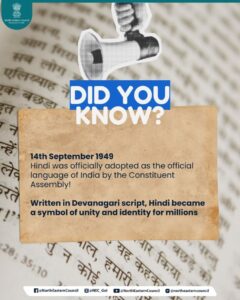
Constituent Assembly Decision
- Official, not National: Hindi in Devanagari as official; “national” rejected to avoid alienation.
- Munshi–Ayyangar Formula: Hindi in Devanagari; international numerals; English retained for 15 years; later continued via Official Languages Act (1963).
- Compromise Outcome: Balanced Hindi promotion with English continuity; prevented North–South linguistic divide.
Key Debates & Positions
- RV Dhulekar (UP)
- Wanted Hindi as national language.
- Criticized delay in replacing English.
- Dismissed Hindustani/Urdu demands.
- Frank Anthony (Central Provinces)
- Advocated retention of English.
- English as international asset, not colonial baggage.
- Lakshmi Kanta Maitra (Bengal)
- Proposed Sanskrit as official/national.
- Argued lack of trained Hindi teachers, resources.
- Qazi Syed Karimuddin (Central Provinces)
- Supported Hindustani (Hindi + Urdu scripts).
- Invoked Gandhi’s support, inclusive Hindu–Muslim link.
- T A Ramalingam Chettiar (Madras)
- Accepted Hindi only due to numerical strength, not merit.
- Denied Hindi as national; all regional languages equally national.
Aftermath
- Protests (1965): Tamil Nadu, non-Hindi states resisted Hindi imposition.
- Official Languages Act: Ensured continued dual use of Hindi + English.
- Current Framework: Hindi + English official at Union; 22 languages in 8th Schedule recognised as national richness.
Test Your Knowledge 03
Q3. With reference to the official language provisions of the Indian Constitution, consider the following statements:
- Article 343 declares Hindi in Devanagari script as the official language of the Union.
- The Constitution originally allowed English to continue for all Union official purposes for 10 years.
- The form of numerals to be used for Union purposes was the international form of Indian numerals.
Which of the statements given above is/are correct?
(a) 1 and 2 only
(b) 1 and 3 only
(c) 2 and 3 only
(d) 1, 2 and 3
Hint : Constitution permitted English for 15 years, not 10 → so statement 2 is wrong.
Q4. The Munshi–Ayyangar formula in the Constituent Assembly primarily dealt with:
(a) Distribution of legislative subjects between Union and States
(b) Special provisions for minorities and backward classes
(c) Official language and continuation of English
(d) Financial relations between Union and States
Hint: Munshi–Ayyangar formula was a compromise on official language (Hindi + English).
IE Opinion: SC’s interim order offers no relief from several problematic provisions of Waqf law
Syllabus: Pre/Mains – Polity
Why in News?
SC issued interim order on challenges to Waqf (Amendment) Act, 2025; stayed only limited provisions, leaving most intact.

Court’s Interim Order
- Lengthy 128 pages, unusual for interim order
- Stayed Section 3(r) – “practising Muslim” rule, pending rules (5 yrs)
- Stayed Section 3(c) – executive determination of title (violation of separation of powers)
- Refused stay on most other provisions
Key Issues and Court’s Reasoning
- Waqf by user: Abolition upheld; justified due to govt land encroachment; setback to petitioners
- Ownership rights: Non-Muslims barred from creating waqf; Court upheld despite past HC/SC rulings (Nagpur 1956, Madras 1930, Lahore 1940)
- Limitation law: Applied uniformly; unlike Hindu endowment exemptions (AP, Telangana, TN)
- Practising vs professing Islam: Shift empowers officials to judge religiosity; risk of moral policing
- Registration window: No extension beyond 6 months; petitioners disappointed
- Council/Board composition: Fixed no. of non-Muslims; diversity vs Art. 26 right of denomination
- Comparison with trusts: Waqf perpetual, irrevocable, inalienable; distinct from trust
Implications
- Petitioners gained small relief only (Sec 3(c), 3(r))
- Major setbacks on user waqf, ownership rights, limitation period
- Waqf Boards = statutory authorities (Art. 12), not private land mafia
- Implementation of Waqf Act 2025 continues with minor modifications
- Missed chance for uniform law across religious endowments (possible UCC link
Test Your Knowledge 04
Q4. In the context of waqf and related property rights, which of the following statements is correct?
(a) A waqf, unlike a trust, vests ownership of property in God and is perpetual, irrevocable, and inalienable.
(b) A waqf is similar to a trust, as both allow the founder to retain personal benefits from the property.
(c) Both waqf and trust laws in India allow non-Muslims to create waqf freely.
(d) Waqf property is managed by private religious leaders and not statutory bodies under Article 12.
Hint: Waqf ≠ Trust; in waqf, property belongs to God, not the founder, and management is by statutory waqf boards (Art. 12), not private clerics. (Answer a)
IE Opinion: New Income Tax Act 2025 expands state’s digital surveillance powers, marks a constitutional overreach
Syllabus: Pre/Mains – Economy
Why in News?
Income-Tax Act, 2025 grants sweeping digital search powers to tax officials, raising concerns of constitutional overreach, privacy violations, and conflict with Puttaswamy & DPDP Act.

Key Provisions & Changes
- Repeals IT Act, 1961 → modernised structure, tax year system
- Section 261(e): “computer system” includes virtual digital space
- Section 132 powers extended from physical premises → cloud, emails, WhatsApp, social media
- Claimed safeguards: higher authority approval, recorded reasons, judicial review (ex post facto)
Constitutional & Legal Concerns
- Puttaswamy (2017): legality–necessity–proportionality test violated
- Pooran Mal (1974) precedent outdated (pre-privacy era)
- No judicial warrant → officers as judge & executor
- Conflict with DPDP Act, 2023 → breaches purpose limitation, data minimisation
- Routine tax probes wrongly equated with national security exemptions
Risks & Implications
- Privacy erosion: intrusion into personal/professional communications
- Chilling effect on free speech, online dissent, political mobilisation
- Potential misuse: target opponents, surveillance tool
- Weak oversight: sanctioning authorities rubber-stamp approvals
- Disproportionate means: social media data rarely relevant to taxable income
Democratic & Legislative Issues
- Hasty passage: limited debate, Select Committee sidelined
- Lost chance: pruning arbitrary powers, introducing judicial oversight
- Enlarges surveillance powers instead of reforming them
- Risks undermining democratic freedoms & constitutional rights
Comparative Perspective
- US, UK, EU: judicial warrants mandatory for digital search/seizure
- Safeguards: proportionality, minimisation, confidential handling
- Indian model: ex post facto review only, inadequate protection
Test Your Knowledge 05
Q5. The Digital Personal Data Protection Act, 2023 (DPDP Act) is in conflict with provisions of the Income-Tax Act, 2025 because:
- DPDP Act is based on principles of purpose limitation and data minimisation.
- Tax department’s unfettered access to social media and private communications breaches these principles.
- DPDP Act allows no exemptions for government agencies.
Which of the statements given above is/are correct?
(a) 1 and 2 only
(b) 2 and 3 only
(c) 1 and 3 only
(d) 1, 2 and 3
Hint: DPDP Act has broad exemptions but not meant for routine tax probes. (Answer a)
IE Explained: India US corn trade: Why does India not import corn from the US?
Syllabus: Pre/Mains – Economy
Why in News?
India unlikely to cut tariffs or allow GM corn imports despite US pressure, amid Bihar elections and domestic sensitivities.
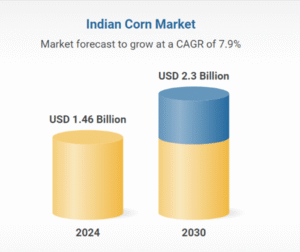
India’s Import Policy & Barriers
- Tariff: up to 0.5 mt at 15%, beyond 50% duty
- GM ban: no GM corn import or cultivation allowed
- Small US share: only 1,100 tonnes (2024–25); imports mainly from Myanmar, Ukraine
- NITI Aayog proposal withdrawn: GM maize for ethanol only
US Concerns & Push
- World’s largest corn producer & exporter
- 2024–25: 377.6 mt produced, 71.7 mt exported
- 2025–26 projections: 427.1 mt production, 75 mt exports
- Losing China: imports fell from $5.2 bn (2022) to $0.33 bn (2024) → desperation for new markets
- US corn 94% GM; cheap price $4.29/bushel (<₹15/kg) vs India MSP ₹24/kg
India’s Domestic Context
- Rising demand: USDA projects corn consumption 34.7 mt (2022–23) → 62–200 mt by 2050
- Demand drivers: livestock, poultry, dairy, ethanol
- Bihar elections: state 3rd largest maize producer (after Karnataka, MP) → tariff cuts politically sensitive
- Farmer protection: MSP ₹24/kg, wholesale ₹22–23/kg vs US cheaper imports
Test Your Knowledge 06
Q6. Why is the United States pushing India to open its corn market?
(a) China has drastically reduced its corn imports from the US.
(b) India’s domestic corn demand is projected to rise sharply with income growth.
(c) US corn is largely non-GM and easily exportable.
(d) India is already the largest importer of US corn in Asia.
Hint: India’s projected demand growth is the core reason; China’s exit triggered urgency, but not the main structural driver.
Answer: (a) and (b) are true, but UPSC format expects one correct → (a) is factually correct, but (b) is the main long-term reason.
IE Opinion: Global science, Indian leadership: 10 years of gravitational-wave astronomy and India’s opportunity
Syllabus: Pre/Mains – Science & Tech
Why in News?
10 years since first gravitational-wave detection (2015), India set to play key role through upcoming LIGO-India observatory.
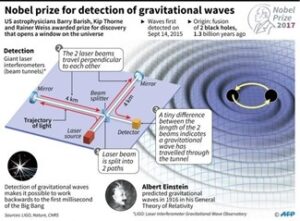
Gravitational Waves: Concept & History
- Einstein’s General Relativity (1915) → spacetime curvature, ripples = gravitational waves
- Initial doubts (Einstein, others); consensus only post-1950s
- Joseph Weber’s aluminium bar detectors (1960s–70s) → unverified claims
- Binary pulsar (Hulse–Taylor, 1974) → orbital decay matching GR prediction → indirect proof (Nobel 1993)
- Interferometry idea (Rainer Weiss, Kip Thorne, 1970s) → foundation of LIGO
LIGO & Global Discoveries
- First detection: Sept 14, 2015 → black hole merger, Nobel Prize 2017 (Weiss, Thorne, Barish)
- 200 events detected (black-hole mergers, neutron star collision)
- Multi-messenger astronomy (GW + light) → cosmic expansion rate, element formation (gold, platinum)
- GR tested in extreme regimes (near-light-speed collisions, massive objects)
- Open puzzles: massive black holes, possible primordial black hole
Global Collaboration
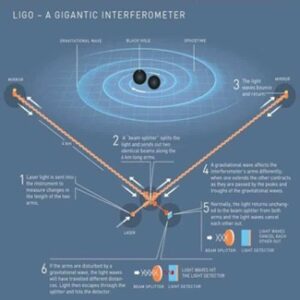
- GW detection needs extreme precision (disturbances < size of proton)
- Single detector insufficient → global triangulation needed
- LIGO (US) + Virgo (Europe) + KAGRA (Japan) → 1200+ scientists, 18 nations
- Ongoing upgrades → higher sensitivity, 1000s of signals expected
India’s Role & Opportunity
- 30+ years of Indian contributions (theory, data analysis, simulation)
- 100+ Indian scientists, 17 institutions in LIGO-Virgo-KAGRA
- LIGO-India (Maharashtra) under construction → collaboration with US, global partners
- Geographic advantage (antipodal to north observatories) → sharper sky localisation
- Technology spillovers → lasers, precision optics, quantum metrology
- Boost to Indian science ecosystem, global leadership in frontier physics
- Challenges: cost, infrastructure, skilled manpower, long timelines
Test Your Knowledge 07
Q7. With reference to gravitational waves, consider the following statements:
- They were first directly detected by LIGO in 2015 from a black hole merger.
- Their existence was first indirectly confirmed through binary pulsar observations.
- Gravitational waves travel slower than light because they are disturbances in gravity, not radiation.
Which of the statements given above is/are correct?
(a) 1 only
(b) 1 and 2 only
(c) 2 and 3 only
(d) 1, 2 and 3
Hint: Eistein’s predictions – GW = ripples in spacetime → travel at speed of light (so statement 3 is wrong).
Q8. Which of the following pairs are correctly matched?
- Joseph Weber – First experimental attempts with resonant bars
- Rainer Weiss – Idea of interferometric detection
- Hulse & Taylor – Binary pulsar evidence of GW emission
- Kip Thorne – Discovery of the first gravitational-wave signal
(a) 1, 2 and 3 only
(b) 1 and 4 only
(c) 2, 3 and 4 only
(d) 1, 2, 3 and 4
Hint: The 2015 detection was by LIGO collaboration, not by Kip Thorne personally
