
Kalam IAS Academy was founded by a team of committed individuals who believe that the traditional way of UPSC preparation needs to be changed.
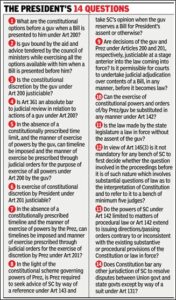
IE Explained: Issues in SC hearings on timeline for the President and Governors to assent to Bills
Syllabus: Pre/Mains – Polity
Why in News?
SC reserved opinion on Presidential reference (Art. 143) regarding whether timelines can be fixed for President/Governors to assent to Bills.
Nature of Reference
- Article 143: President may seek SC opinion on questions of law/public importance.
- SC not bound to answer; past refusals exist.
- States’ view: Reference = disguised appeal/review of April ruling; undermines stare decisis.
- Centre’s view: Advisory jurisdiction distinct; can clarify constitutional doubts despite past rulings.
Governor’s Powers
- States: Bound by aid & advice ( 163); primacy of elected govt; Governors ≠ Viceroys.
- Centre: Not mere “postman”; discretionary powers exist; Constituent Assembly rejected removal of discretion.
- Example: 2004 Punjab River Water Termination Act → struck down in 2016.
Governor’s Veto / Withholding Assent
- SC April ruling: No “pocket veto”; must act.
- Centre: Withholding = Bill lapses; echoes colonial GOI Act, 1935 “absolute veto.”
- States: Colonial veto powers intentionally omitted; Governors must act.
- Data: 1970–present → ~17,000 Bills, only ~20 withheld; 90% assented within 1 month.
Timelines for Assent
- Centre: SC cannot fix timelines; Constituent Assembly deleted 6-week limit; “as soon as possible” = flexible; judicial timelines = “judicial amendment.”
- Political resolution preferable over judicial diktat.
- States: “As soon as possible” implies immediacy; timelines in April ruling = trigger for judicial review, not automatic assent.
States & Fundamental Rights
- Centre: 32 remedies for individuals, not states; Governors ≠ Union agents.
- States: Right to move SC essential; Governors = Union-State link; denial weakens federal balance.
- Even NDA ally Andhra Pradesh supported states’ writ rights.
| Centre’s/State’s Arguments in Governor’s or President’s Veto Powers – Summary | ||
| Issue | State’s Argument | Centre’s Argument |
| Nature of Reference (Art. 143) | Reference = disguised appeal/review of April ruling; violates stare decisis | Advisory jurisdiction distinct; SC can clarify constitutional doubts even after rulings |
| Governor’s Powers (Art. 163) | Bound by aid & advice; primacy of elected govt; Governors ≠ Viceroys | Not mere “postman”; discretionary powers exist; Assembly rejected removal of discretion |
| Veto / Withholding Assent | Governors cannot sit indefinitely; colonial veto powers omitted | Withholding = Bill lapses; echoes colonial GOI Act 1935 absolute veto |
| Timelines for Assent (Art. 200) | Bound by aid & advice; primacy of elected govt; Governors ≠ Viceroys | Not mere “postman”; discretionary powers exist; Assembly rejected removal of discretion |
| States & Fundamental Rights (Art. 32) | States must have right to move SC; Governors = Union-State link | Art. 32 remedies only for individuals; Governors not Union agents |
Test Your Knowledge 01
Q1. Consider the following pairs of cases and their relevance to Governor’s powers:
- Shamsher Singh v. State of Punjab (1974) – Limited scope of Governor’s discretionary powers.
- K. Pavitra case (2019) – Reaffirmed Governor’s wide discretion in reserving Bills.
- State of Tamil Nadu v. Governor of Tamil Nadu (2025) – Held that “pocket veto” by Governor is unconstitutional.
Which of the above pairs is/are correctly matched?
(a) 1 and 2 only
(b) 1 and 3 only
(c) 2 and 3 only
(d) 1, 2 and 3
Hint: Pavitra (2019) had confusion; later called per incuriam.
Q2. Consider the following statements regarding Article 143 (Presidential Reference):
- The Supreme Court is constitutionally bound to provide its opinion when the President refers a question of law or fact.
- In the past, the Supreme Court has declined to answer Presidential References.
- The opinion given by the Supreme Court under Article 143 is binding on the President.
Which of the statements given above is/are correct?
(a) 2 only
(b) 1 and 3 only
(c) 2 and 3 only
(d) 1, 2 and 3
Hint: Opinion is advisory, not binding; SC may refuse
| News | Ethical Issues |
Charlie Kirk shot dead in USNews: Conservative activist Charlie Kirk was fatally shot on September 10, 2025, at Utah Valley University, sparking widespread controversy over political violence, free speech suppression, and organized retaliation campaigns against his critics. |
|
Gaza CrisisNews: Israel launched a major ground offensive in Gaza City on September 15, 2025, after ordering 350,000 residents to evacuate, with total war casualties reaching 66,700 people (83% civilians) and a UN commission concluding Israel committed genocide. |
|
Manki-Munda Self-Governance
Why in News?
Sept 9, 2025: Ho adivasis in West Singhbhum, Jharkhand, protested against DC’s alleged interference in Manki-Munda self-governance.
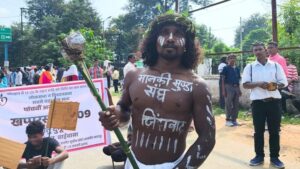
Traditional System
- Munda: hereditary village head; settles socio-political disputes.
- Manki: head of 8–15 villages (pir); hears unresolved cases.
- Decentralised, internal; no tax/revenue role originally.
- Hereditary succession; posts also include assistants.
Colonial Transformation
- East India Company: taxation post-Plassey (1757), Buxar (1764), Permanent Settlement (1793).
- Ho, Kol revolts (1821–22, 1831–32) against land seizure.
- Compromise: British recognised system under Wilkinson’s Rules (1833, 31 rules).
- Kolhan Government Estate (1837) created; Mundas/Mankis became intermediaries.
- Impact: influx of outsiders (dikkus) → 1,579 (1867) → 15,755 (1897); private property concept; raiyats, pattas introduced.
Post-Independence Continuity
- Kolhan Government Estate dissolved 1947, but Wilkinson’s Rules continue.
- Courts upheld customs (till 2000); Mora Ho vs State of Bihar: rules = customs, not law, but allowed continuation.
- Jharkhand govt 2021: Nyaya Panch recognised for revenue, law & order, land disputes.
Present Conflict
- Complaints: Mundas blocking OBC/SC livelihoods, absenteeism, delay in documents.
- DC’s 9-point directive: transparency, based on Hukuknama 1837; misinterpreted as removal.
- Administration view: no interference, only clarification.
- Vacant posts: 1,850 sanctioned; ~200 vacant; 50 filled via Gram Sabhas.
Larger Issues
- Tribal autonomy vs state oversight: fear of erosion of self-rule.
- Hereditary leadership: uneducated leaders struggle in modern bureaucracy.
- Youth voices: demand reforms, merit-based selection.
- Non-tribal raiyats: sometimes bypass system → resentment.
- DC’s role today: limited but crucial in succession, land disputes, interpretation.
Significance
- Cultural survival: symbol of Ho identity, resistance to outsiders.
- Legal anomaly: pre-colonial/colonial rules still valid; partial exemptions from civil laws.
- Federal/tribal governance debate: autonomy, integration, reform.
Govt employees can opt for UPS till September 30
Why in News?
Govt employees have time till Sept 30, 2025 to opt for Unified Pension Scheme (UPS); uptake remains very low.

What is UPS?
- Announced: Cabinet, Aug 2024; effective Apr 1, 2025.
- Coverage: Central govt employees under NPS (post-Jan 1, 2004 entrants).
- Nature: Optional (not mandatory like NPS).
- Assured pension: 50% of average basic pay (last 12 months) with 25 yrs service.
- Family pension: 60% of pension to spouse on death.
- Minimum guarantee: ₹10,000/month after 10 yrs service.
- Corpus: Govt contribution 8.5% of basic + DA.
- Lump sum: 1/10th of last basic + DA for each completed 6 months.
- Ineligible: Dismissed employees.
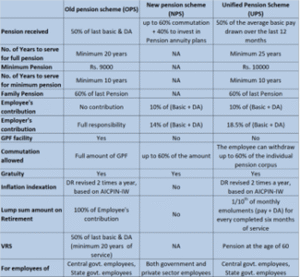
UPS vs NPS vs OPS
- OPS: No contribution; 50% of last drawn pay + DA; fully govt funded.
- NPS: Employee 10% + Govt 14%; market-linked, no assured payout, corpus-based.
- UPS: Employee 10% + Govt 10% + Govt 8.5% corpus; assured payout (50% avg basic of last yr).
- Flexibility: UPS subscribers can revert to NPS once (before superannuation/VRS).
Why Slow Uptake?
- Low trust: Employees still demand OPS restoration.
- Perception: UPS ≠ OPS (lower benefits, contribution burden).
- Awareness gap: Ongoing govt outreach (Sep 9 meeting with ministries).
- Short window: Initial deadline June 30, extended to Sept 30.
- Data: Only 40,000 opted out of 23.94 lakh NPS employees (as of Sep 15)
