
Kalam IAS Academy was founded by a team of committed individuals who believe that the traditional way of UPSC preparation needs to be changed.

IE Explained: How scientists found an ant which gives birth to two species
Syllabus: Pre/Mains – Science & Tech
Why in News?
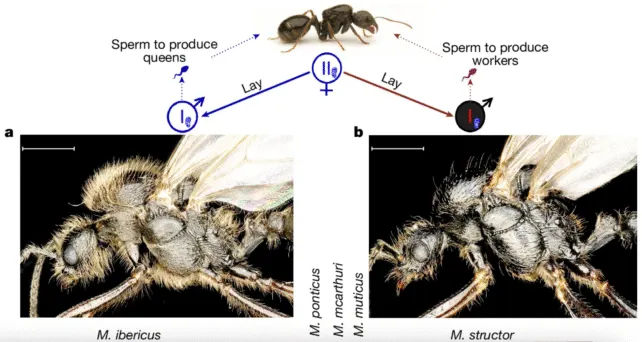
A study published in Nature (Sept 2025) found that queens of Mediterranean harvester ant Messor ibericus can give birth to males of another species (Messor structor).

Key Discovery
First known case of a single organism producing offspring of two species.
M. ibericus queens produce:
Female queens (M. ibericus)
Hybrid sterile workers (M. ibericus × M. structor)
Male drones (M. structor)
Suspicion & Evidence
Workers = hybrids, 50% DNA of M. structor
Colonies existed where no M. structor colonies nearby
DNA tests confirmed M. structor males inside M. ibericus colonies, with M. ibericus mitochondrial DNA → maternal origin
Mechanism
Queens store sperm in spermatheca
About 10% eggs = entirely M. structor, not hybrid
Process: cloning sperm genome + maternal mitochondria → pure M. structor males
Evolutionary Advantage
Producing two species of males ensures colony survival, genetic diversity, and resilience.
Significance
Challenges the classical rule: offspring = same species as parents
Example: “like a human having chimp babies”
Provides new insight into speciation, hybridisation, and reproductive strategies
Test Your Knowledge 01
Q1. In the context of recent scientific discoveries, what is unique about the reproduction of Messor ibericus ants?
(a) Queens can reproduce without fertilisation (parthenogenesis)
(b) Queens can give birth to offspring of two different species
(c) Queens produce only sterile worker ants through cloning
(d) Male ants carry both paternal and maternal mitochondrial DNA
Hint: The “two species offspring” aspect is the unique discovery.
IE Explained: Why Army is rushing to procure new radars after Operation Sindoor drone breaches
By Amrita Nayak Dutta
Syllabus: Pre/Mains – Security Link
Why in News?
After Operation Sindoor (May 2025) exposed gaps in India’s radar capabilities against Pakistani drone swarms, the Army is fast-tracking procurement of new systems.

Radar Basics
RADAR = Radio Detection and Ranging
Components: transmitter + receiver
Functions: detect, track, identify, calculate trajectory
Types:
Surveillance radars → monitor skies
Fire control radars → guide weapons to targets
Key metric: Radar Cross Section (RCS) = detectability (low RCS = stealthy)
Current AD Radars
IAF uses High/Medium Power Radars (HPRs, MPRs) for long-range, high-altitude threats
Army + IAF use Low Level Light Weight Radars (LLLRs) for low altitude objects
Fire control radars:
IAF: 3D Central Acquisition, Rajendra
Army: Flycatcher (USFM upgrade), AD Tactical Control
Why Upgrade is Needed
Operation Sindoor saw hundreds of cheap drones breaching airspace, camouflaged with attack drones
Old radars struggled with low-RCS, low-altitude swarms
Modern warfare trend: drones & swarms (e.g., Hamas-Israel)
Need for more advanced LLLRs and fire control radars with friend-foe ID
New Procurement
45 Low Level Light Weight Radars (Enhanced)
48 Air Defence Fire Control Radars – Drone Detectors (ADFCR-DD)
10 Low Level Light Weight Radars (Improved)
Capabilities:
Detect and track small drones and swarms
Prioritise threats
Transmit target data to AD weapons (up to 10 km)
ADFCR-DD: detect, classify, control AD guns/missiles
India’s AD Infrastructure
Systems: Akash missile, S-400, AD guns
Army: Akashteer → real-time common air picture, integrated ops
IAF: IACCS → integrates all AD assets, controls offensive + defensive ops
Mission Sudarshan Chakra: build comprehensive AD shield
Recent: DRDO tested Integrated Air Defence Weapon System (IADWS)
Test Your Knowledge 02
Q2. In the context of radar technology, the term Radar Cross Section (RCS) refers to:
(a) The area covered by radar beams in circular scanning
(b) The effective reflectivity of a target to radar signals
(c) The cross-sectional size of radar antenna dish
(d) The minimum distance at which radar can detect targets
Hint: RCS = detectability, key in stealth design.