
Kalam IAS Academy was founded by a team of committed individuals who believe that the traditional way of UPSC preparation needs to be changed.
IE Explained: Saudi Arabia – Pakistan defence pact: What it means for the two countries
Syllabus: Pre/Mains – International Relations
Why in News?
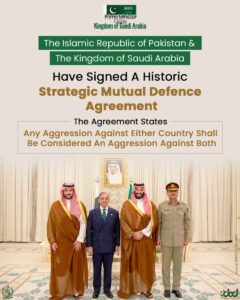
Saudi Arabia and Pakistan signed a “Strategic Mutual Defense Agreement” on 17 September 2025 under which both commit to treat “any aggression against either country” as aggression against both.
Context
- Long-standing military cooperation
Defence, training, advisory and deployment links since the 1960s; Pakistan has supported Saudi Arabia militarily on several occasions (e.g. after the 1979 Grand Mosque incident). - Regional insecurity and shifting alignments
Rising instability in the Middle East (e.g. Israeli strikes, tensions with Iran, uncertainty about US reliability in some Gulf state security) making Gulf states revisit their security guarantees. - Pakistan’s fiscal needs
Saudi investment, funding and security cooperation are particularly beneficial for Pakistan as it faces economic and fiscal constraints. Formalising the pact helps to translate informal ties into more predictable guarantees.
Key Features of the Pact
- Mutual defence clause
If one party is attacked, the other treats it as an attack on itself. - Scope & ambiguity
Details on how the pact is operationalised (which threats qualify, what triggers action) are not fully public. It is not clear how nuclear sharing or deterrence works under this. Some statements suggest Pakistan’s capabilities “will be available” under the pact, yet official Pakistani line also says nuclear weapons are not on the radar. - Defensive rather than aggressive framing
Pakistan has emphasised this is not a pact aimed at offense or naming specific enemies — more an umbrella for deterrence.
Implications for Saudi Arabia & Pakistan
- Saudi Arabia: enhances deterrence, supports security assurances beyond just buying arms; gains backing in case of external threats (from Iran, Yemen, or spillovers from Israel-Palestine conflicts) with a nuclear-armed partner.
- Pakistan: gets formal guarantees, possibly financial backing, and increased strategic importance; consolidates its role as a security actor in the Islamic world.
India’s Position & Concerns
- Cautious reaction: The Indian government has acknowledged the pact, said it was under consideration, and is studying its implications for India’s national security and regional stability.
- Concern over nuclear umbrella aspect: Some media reports quote Pakistani defence officials saying Pakistan’s “capabilities will be available under this pact,” raising fears in India that Saudi Arabia could, in effect, gain access to Pakistan’s nuclear deterrent. India would see that as a strategic risk.
- Political reactions: Opposition parties in India are expressing worry; Congress, for instance, calls this a challenge to India’s security.
- Expectation from Saudi Arabia: India is urging Saudi Arabia to “mind sensitivities” — that is, consider Indian perceptions and interests even as it deepens ties with Pakistan.
- Strategic balancing: India will likely respond via diplomatic means, possibly engaging Gulf partners more deeply, reinforcing its own security and regional relationships, and watching for operationalisation of the pact more than rhetoric.
Test Your Knowledge 01
Q1. Consider the following about mutual defence agreements:
- NATO’s Article 5 is an example of a collective defence clause.
- The recently signed Saudi–Pakistan pact has a similar “attack on one is attack on all” clause.
- The SEATO treaty (1954) also had a collective defence clause, binding all members to automatic military action.
Which of the above are correct?
(a) 1 and 2 only
(b) 2 and 3 only
(c) 1 and 3 only
(d) 1, 2 and 3
Hint: SEATO’s clause was weaker, no automatic military obligation.
IE Explained: Why low inflation is a problem for governent’s problem for government’s finances, Budget targets
Why in News?
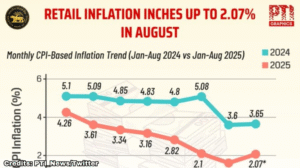
CPI inflation (Aug 2025) at 2.07%, WPI at 0.52% → boon for consumers, strain on govt finances & Budget math.
Impact on Govt Finances
- Nominal GDP Link
- Govt uses nominal GDP for tax, fiscal deficit, debt ratios.
- Budget FY26 assumed 10.1% growth; actual Q1 nominal growth 8.8%.
- Weak price growth → lower nominal GDP despite real GDP at 7.8%.
- Tax Revenue
- Apr–Jul: gross tax rev +1% YoY; net tax rev –7.5%.
- Budget expected ~11% growth.
- GST rate cuts → further dampening inflation & revenues.
- Fiscal Targets
- Revised FY25 GDP base: ₹331 lakh cr (↑2%).
- FY26 target: ₹357 lakh cr → needs only 8% growth.
- Fiscal deficit target 4.4%, debt-GDP 56.1% achievable if nominal GDP met.
- Risk: slower growth → revenue shortfall, higher deficit.
Why Low Inflation Matters?
- Positive Side
- Relief to households.
- Better purchasing power.
- Negative Side for Govt
- Slows nominal GDP growth → weakens tax buoyancy.
- Past 13 yrs: Budget nominal GDP overstated in 9 yrs.
- Nominal growth likely 8.3% FY26 (below target).
Structural Concerns
- Corporate Profits
- Apr–Jun: sales +5.5%, profits +17.6%.
- Manufacturers: sales +5.3%, profits +27.7%.
- Profit margins strong, cash piles large.
- Investment Sentiment
- Weak capex despite profits.
- Not driven by productivity gains; oversupply/demand weakness suspected.
- Low inflation sustainable only if from productivity, not demand slack.
Test Your Knowledge 02
Q2. Consider the following statements:
- Real GDP is adjusted for inflation, while nominal GDP is not.
- Government’s fiscal deficit and debt-to-GDP ratios are calculated using nominal GDP.
- A fall in inflation always benefits government’s tax revenue collection.
Which of the above is/are correct?
(a) 1 only
(b) 1 and 2 only
(c) 2 and 3 only
(d) 1, 2 and 3
Hint: Real vs Nominal → adjustment; Fiscal ratios use Nominal; Low inflation reduces tax buoyancy.
Q3. Assertion (A): Low CPI and WPI inflation are good for consumers but may pose a challenge for government finances.
Reason (R): Fiscal deficit and debt ratios are measured against nominal GDP, which slows down when inflation is subdued.
(a) Both A and R are true, and R is the correct explanation of A.
(b) Both A and R are true, but R is not the correct explanation of A.
(c) A is true, but R is false.
(d) A is false, but R is true.
Hint: Low inflation ↓ nominal GDP → weaker tax revenues & fiscal ratios.
Trump’s H-1B Visa Fee Proclamation
What happened?
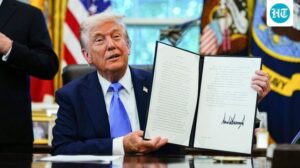
- Trump signed proclamation on September 19, 2025 requiring a $100,000 annual fee for H-1B visa applications, effective September 21, 2025
- Fee structure: $100,000 per year for each of the three years of visa duration, paid by employers on top of existing processing costs
- Entry restriction: H-1B workers will be denied entry unless their employer pays this fee
- Part of “Project Firewall”: Department of Labor enforcement initiative to crack down on H-1B visa abuse
Implications for India
- Impact on Indian Tech Workers: 71% of H-1B visa holders are Indian
- Current Indian professionals may face limited job mobility and costly renewals
- Indian IT Companies Face Major Business Model Disruption: Companies like TCS, Infosys, and Wipro that rely heavily on H-1B transfers for client projects will be severely impacted
- Dramatic Decline in US Education Appeal for Indians: 78% of Indian students would abandon US study plans if H-1B opportunities disappear, according to recent polls
- Startup and SME Sector Opportunities Vanish: Small companies and startups cannot afford $100,000 annual fee, eliminating opportunities for thousands of Indian professionals
- Brain drain reversal potential: Highly skilled Indians may increasingly choose to remain in India or move to more welcoming countries