
Kalam IAS Academy was founded by a team of committed individuals who believe that the traditional way of UPSC preparation needs to be changed.

IE Explained: PM Modi says ‘GST savings festivals’ begins: with lower prices, how household budgets are set for boost
Syllabus: Pre/Mains – Economy
Why in News?
PM Modi announced launch of ‘GST Savings Festival’ as new GST rates (GST 2.0) took effect from Sept 22, 2025, reducing taxes on 375+ common-use goods and services.
Key Features of GST 2.0
- GST Council decision: 56th meeting (Sept 3, 2025).
- Coverage: FMCG, household items, cement, durables, automobiles, insurance.
- Monitoring: Finance Ministry to track price pass-through.
- Aim: Boost consumption, reduce inflation, support middle class & youth.
Cheaper Essentials
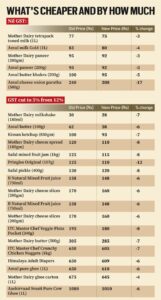
- Milk products: Paneer exempt (↓3%), UHT milk (↓3%), butter & cheese slices (↓6%), Amul paratha (↓17%).
- Packaged foods: Pringles (↓12%), Kellogg’s cornflakes (↓11%), Sunfeast biscuits (↓12%).
- Ice creams: Mother Dairy vanilla cup (↓10%), Butterscotch cone (↓14%).
- Condiments: Ketchup, ghee, pickles, jams (↓4–8%).
Household & Personal Care
- Items: Shampoo, soap, toothpaste, hair oil.
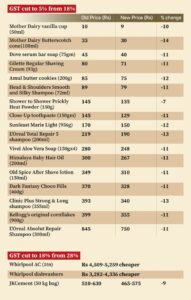
- Rate cut: 18% → 5%.
- Impact: Prices ↓11–13% (brands: Dove, L’Oréal, Himalaya, Close-Up).
Non-Food & Services
- Cement: 28% → 18%, ↓~10% (JK Cement, UltraTech).
- Insurance: Health & life premiums exempt (↓~15%).
- Durables: ACs cheaper by ₹4.5k–₹5.2k, dishwashers ↓₹3.2k–₹4.3k.
Automobiles
- Small cars: GST 18% vs earlier 28%+cess.
- Maruti Suzuki: Cuts ₹46,400–₹1.29 lakh.
- Dealer issue: Stock at old rates → unsold, est. loss ₹2,500 crore.
- Bigger cars: Now 40% GST vs ~50% earlier.
Economic Impact
- Boost to demand: FMCG, housing, autos, durables.
- Lower inflation: Household budgets eased.
- Savings channel: Extra income can shift to savings/investment.
- Sectoral ripple: Cement & construction → MSME growth, jobs.
Test Your Knowledge 01
Q1. Which of the following items became GST exempt (0%) after the September 2025 reforms?
- Packaged paneer
- Amul cheese onion paratha
- Cement
Select the correct answer using the code below:
(a) 1 only
(b) 1 and 2 only
(c) 2 and 3 only
(d) 1, 2 and 3
Hint: Paneer & paratha exempt; cement only reduced to 18%, not exempt.
IE Opinion: GST 2.0: Reforms at the cost of informal workers
Syllabus: Pre/Mains – Science & Tech
Why in News?
GST 2.0 launched with promises of simplification, lower rates, and formalisation, but risks worsening inequalities and burdening informal workers.
Promises of GST 2.0
- Fewer slabs, simplified structure
- Lower tax on essentials → boost demand
- Goal: unified market, formalised economy
- Reformist narrative: efficiency, self-reliance
Exclusionary Impact
- Compliance costs → heavy for MSMEs, small traders, artisans
- Informal workers → wage cuts, job loss, retrenchment
- “Premature formalisation” → unsustainable for many
- Digital burden → excludes tech-illiterate, marginalised
- Regressive tax burden → poor pay more proportionally
Political & Social Dimensions
- Benefits concentrated in formal firms, upper castes
- Dalits/OBCs in low-capital sectors hit hardest
- Civil society (formal, literate) vs. political society (informal, marginalised)
- GST → tool of selective incorporation, fiscal discipline over rights
State-Level Experiences
- Gujarat: textile/diamond clusters, Dalit-OBC weavers face compliance burden, casualisation
- Punjab: excise rebates lost, informal subcontracting rises, contract jobs increase
- Tamil Nadu: MSMEs (leather/engineering) overburdened; reduced welfare funding
- Kerala: welfare focus, but revenue shortfalls constrain labour protection
Fiscal Federalism Strain
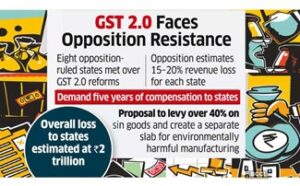
- Reduced compensation → state revenue losses
- Cuts in welfare & employment schemes
- MSME-heavy states disproportionately affected
- Centralisation erodes states’ fiscal autonomy
Governance & Inequality
- GST = not neutral, but governance tool
- Fiscally disciplined “citizen” privileged
- Informal workers doubly excluded → no compliance benefit + welfare cuts
- Reinforces caste/class hierarchies under modernisation rhetoric
Way Forward
- Simplify compliance for MSMEs
- Exempt labour-intensive sectors
- Strengthen fiscal transfers, welfare funding
- Equity-oriented fiscal federalism
- Pair tax reform with worker protections & social safety nets
Test Your Knowledge 02
Q2. Which of the following best explains the term “premature formalisation” in the context of GST 2.0?
(a) Forcing large corporations to file returns more frequently.
(b) Integrating informal enterprises into a tax-compliance regime before they are ready.
(c) Expanding GST to cover international e-commerce.
(d) Formalising welfare schemes into direct tax credits.
Hint: Informal MSMEs struggle with compliance without adequate handholding.