
Kalam IAS Academy was founded by a team of committed individuals who believe that the traditional way of UPSC preparation needs to be changed.
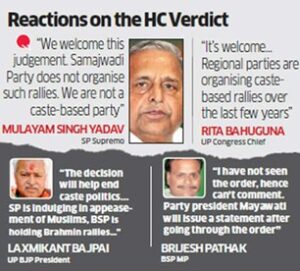
IE Explained: UP caste-based rallies banned: The HC ruling behind the state govt order
Syllabus: Pre/Mains – Society
Why in News?
UP govt issued order banning caste-based political rallies, caste display on vehicles/signboards, and caste mention in police records → based on Allahabad HC judgment (Sept 16, 2025).
HC Case Background
- Case: Praveen Chetri v. State of UP → liquor smuggling accused
- FIR/seizure memo recorded caste of accused (Mali, Thakur, etc.)
- Court: caste mention “regressive, anti-secular, anti-modern”
- Directed DGP affidavit → rejected justification (ID purpose)
HC Observations
- Caste system = threat to secularism, national unity, integrity
- Caste identifiers on vehicles/homes/social media = “cultural narcissism,” “toxic digital masculinity”
- Caste bias embedded in State, esp. police practices
- Invoked reformers: Ambedkar, Phule, Narayana Guru, Vivekananda, Roy, Dayanand, Vinoba, Veeresalingam
- Promotion of caste identity = “anti-national”
HC Directions (Binding)
- Delete caste/tribe column in police forms, notices, CCTNS portal
- FIRs, arrest memos, recovery memos → no caste mention
- Remove caste-based signboards in public spaces
- Frame SOPs → prohibit caste disclosure in investigation
HC Recommendations (Non-Binding)
- Amend MV Rules → ban caste slogans/identifiers on vehicles
- Amend IT Rules 2021 → flag caste-glorifying/hate content
- Media literacy + anti-casteism campaigns (youth platforms)
- Citizen monitoring/reporting portals, mobile apps
UP Govt Order (Sept 22, 2025)
- Ban: caste-based political rallies (public order, unity)
- Vehicles: challan caste stickers/emblems under MV Act
- Public spaces: remove caste signboards/“caste territories”
- Police: caste not in FIRs/records; mother’s name added
- Exception: cases under SC/ST Act
- Social media: monitor caste-hatred; strict action
Key Constitutional & Legal Links
- Art. 14 → Equality before law
- Art. 15(1) → No discrimination by caste
- Art. 17 → Abolition of untouchability
- Art. 19(1)(a) → Free speech vs. caste hate speech limits
- Art. 21 → Dignity & privacy
- SC/ST (Prevention of Atrocities) Act, 1989 → exception for caste mention
- MV Act 1988, IT Rules 2021 → relevant for enforcement
Test Your Knowledge 01
Q1. Which of the following best explains the constitutional basis for the ban on caste-based political rallies by a State Government?
(a) Directive Principles of State Policy under Part IV
(b) Restriction on free speech in the interest of public order under Article 19(2)
(c) Fundamental Duty under Article 51A(e)
(d) Residual powers of the State Legislature under Article 248
Hint: Caste rallies = political expression (Art. 19(1)(a)) → State can curb only under “reasonable restrictions” → specifically, in interest of public order (Art. 19(2)).
TH Text & Context: The mapping of the India-China border
Syllabus: Pre/Mains – International Relations
Why in News?
Debate on India–China boundary alignments revived after The Hindu series (Sept 2025) → counterview citing historical Manchu maps & Simla Conference evidence.
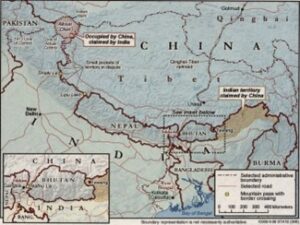
Historical Mapping
- Manchu Rule (1644–1911) → 2 major official maps with Jesuit help
- Kang-hsi Map (1721) → Tibet’s boundary ended at Himalayas; Tawang (south) = non-Tibetan, not part of Tibet
- Ch’ien-lung Map (1761) → Eastern Turkestan not trans-Kunlun; no claim south of Kunlun to Hindu Kush–Karakoram
Simla Conference (1913–14)
- RoC delegate → Tibet had no claim on tribal belt (now Arunachal Pradesh)
- Belt = non-Tibetan, self-governing
- Delegate didn’t claim for China; left to India (already in Assam’s sphere of influence)
- Indo–Tibetan agreement → 1914 alignment
Later Claims & Shifts
- 1899 Proposal → watershed division → Kashmir–Sinkiang boundary (Aksai Chin basis)
- 1943 RoC map → new claims; called “unprecise draft”
- 1947 RoC repetition → during India–Pakistan conflict
- PRC continuation → followed KMT map-making pattern
Chinese Leadership Positions
- Chou En-lai (1954, Peking) → admitted printing old maps; no deliberate boundary change
- Talks with Nehru (1960) → dismissed evidence, avoided Chinese-origin proof
- Strategy → shift to “principles” not documents; trap as per Vijay Gokhale (The Long Game)
- No public evidence of territorial swap proposal (Aksai Chin vs. Arunachal)
Way Forward (then envisioned)
- Package deal → cover entire boundary + trade/geopolitics
- Solution → “no defeat, reasonable, equitable, friendly”
- Possible basis → acceptance of 1899 alignment (Aksai Chin) + 1914 alignment (Arunachal)
- With territorial swap to address security concerns
Core Takeaways
- Manchu maps (1721, 1761) never conceived Tibet/E. Turkestan as trans-Himalayan/trans-Kunlun
- Simla Conference: Tibet/China did not claim Arunachal tribal belt
- Post-1943 → RoC/PRC expanded territorial claims
- Negotiations (1950s–60s) → principles-based resolution attempts; package deal suggested but unresolved
Test Your Knowledge 02
Q2. With reference to the 1914 Simla Convention, consider the following:
- It involved representatives from British India, Tibet, and the Republic of China.
- The Republic of China delegate initialled but refused to sign the final agreement.
- The McMahon Line emerged as a part of this convention.
Which of the above statements are correct?
(a) 1 and 2 only
(b) 2 and 3 only
(c) 1 and 3 only
(d) 1, 2 and 3
Hint: RoC delegate participated, initialled draft, but withheld signature → still McMahon Line drawn.
Prime Minister marks the seventh anniversary of Ayushman Bharat scheme
Why in News?
Prime Minister Modi marked 7th anniversary of Ayushman Bharat scheme on September 23, 2025, celebrating world’s largest government-funded health assurance program that revolutionized Indian healthcare.
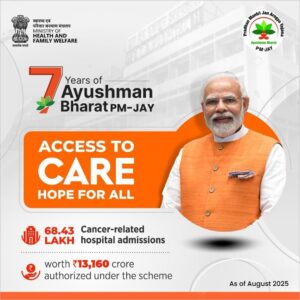
Coverage & Scale
- World’s largest health insurance scheme
- 55 crore beneficiaries covered
- 12 crore families eligible
- Rs 5 lakh annual health cover per family
Achievements in 7 Years
- 30 crore+ hospital admissions authorized
- Rs 1.48 lakh crore cashless care provided
- 42+ crore Ayushman cards issued
- 8 lakh+ Ayushman Arogya Mandirs operational
Financial Impact
- Out-of-pocket health costs reduced: 63% to 39%
- Government health expenditure increased: 29% to 48%
- 6+ crore families protected from poverty annually
- Prevents catastrophic health expenditure
Recent Expansions
- All senior citizens 70+ covered (October 2024)
- ASHA workers, anganwadi workers included (2024)
- 1 crore gig/platform workers being added
Key Features
- Cashless, paperless treatment nationwide
- 1,350+ medical/surgical procedures covered
- Pre-existing diseases covered
- Portable across all states
