
Kalam IAS Academy was founded by a team of committed individuals who believe that the traditional way of UPSC preparation needs to be changed.
IE Explained: Why does Ladakh want to be part of the Sixth Schedule?
Syllabus: Pre/Mains – Polity & Governance
Why in News?
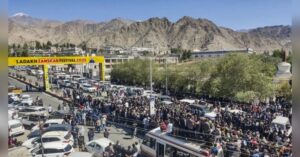
Massive protests in Leh (Sep 24, 2025) → Demand for statehood & inclusion of Ladakh under Sixth Schedule → Violence, deaths, shutdown.
Sixth Schedule Basics
- Constitutional basis → Art. 244(2) & Sixth Schedule.
- Applies to → Assam, Meghalaya, Mizoram (3 ADCs each), Tripura (1 ADC).
- Autonomous District Councils (ADCs) → 30 members (↑ to 40+ in BTC), 5-yr term.
- Powers → Legislation on land, forest, water, agri, customs, inheritance, local policing, mining etc.
- Purpose → Protect tribal identity, self-rule, socio-cultural autonomy.
Why Ladakh Demands Sixth Schedule?
- Loss of representation → UT of J&K has legislature; Ladakh UT doesn’t. Earlier: 4 MLAs in J&K Assembly → now ruled by bureaucrats.
- Identity fears → 97% tribal (Buddhist & Shia Muslim). Domicile policy in J&K fuels fear of land alienation, demographic change.
- Weak local councils → Leh & Kargil Hill Councils exist but limited powers (minor taxes, land allotment). Not equivalent to ADCs.
- Development neglect → Earlier felt dominated by J&K politics (Kashmir/Jammu-centric). Now more alienation from Centre.
- Cultural & linguistic concerns → Distinct Ladakhi identity (Tibetan-Buddhist heritage) under threat.
- Political promises → PM’s 2019 assurance of respecting aspirations; expectations not met.
Support for Inclusion?
- NCST recommendation (2019) → Sixth Schedule for Ladakh due to tribal majority, cultural uniqueness, land safeguards.
- Precedent of special protections → Similar to NE tribal belts → restrict outsider land ownership.
Challenges to Inclusion
- Constitutional limit → Sixth Schedule confined to NE states. Rest of India → Fifth Schedule applies.
- No precedent → Even Nagaland & Arunachal (100% tribal) not under Sixth Schedule.
- Centre’s hesitation → Home Ministry cites legal-constitutional barrier; would need constitutional amendment.
Way Forward
- Govt options → (i) Extend Sixth Schedule via amendment; (ii) Strengthen Hill Councils with ↑ autonomy; (iii) Statehood demand under consideration.
- Stakes → Balancing national integration, local aspirations, tribal identity protection.
Test Your Knowledge 01
Q1. With reference to the Sixth Schedule of the Indian Constitution, consider the following statements:
- It provides for Autonomous District Councils (ADCs) with legislative, judicial, and financial powers.
- It applies to certain tribal areas of Assam, Meghalaya, Mizoram, and Manipur only.
- The Bodoland Territorial Council is the only ADC with power to make laws on more than 30 subjects.
Which of the statements given above is/are correct?
(a) 1 and 3 only
(b) 1 and 2 only
(c) 2 and 3 only
(d) 1, 2 and 3
Hint :
- Stmt 1 True → ADCs have legislative, judicial, financial powers (land, customs, inheritance, local taxes, etc.).
- Stmt 2 Trap → Applies to Assam, Meghalaya, Mizoram, Tripura (not Manipur).
- Stmt 3 True → Bodoland Territorial Council (BTC) → lawmaking on 39 subjects (exception).
IE Opinion: UPSC @ 100: The story of India’s top recruiter
Syllabus: Pre/Mains – Polity & Governance
Why in News?
UPSC enters its centenary year on Oct 1, 2025 (founded 1926 as Public Service Commission).
Origins & Evolution
- 1600s → EIC mercantile servants, no bureaucracy
- 1757 (Plassey), 1764 (Buxar) → shift to ruling role
- Cornwallis, Hastings, Wellesley → bureaucracy reshaped
- 1854 Macaulay Report → merit-based recruitment
- 1855 Civil Service Commission (UK) → extended to ICS (1858)
- 1922 → ICS exams held in India, Indian entry allowed
- 1924 Lee Commission → rec. Public Service Commission
- 1926 PSC estd. → Sir Ross Barker (first chair)
- 1937 → Federal PSC (Govt. of India Act, 1935)
- 1947 → FPSC under H.K. Kripalani (first Indian chief)
- 1950 → FPSC → UPSC; ICS → IAS
Constitutional Mandate
- Article 320 → UPSC to conduct exams for Union/State services
- Independent constitutional body → estd. credibility in democracy
Institutional Development
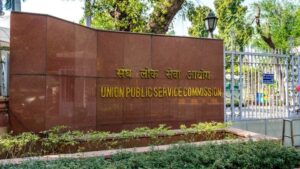
- HQ: Dholpur House, New Delhi (since 1952; erstwhile Raja of Dholpur’s palace)
- Reform commissions →
- ARC (1966), Thorat (1967), Kothari (1976)
- Satish Chandra (1989-90), Alagh (2001), P.C. Hota (2004), Nigavekar (2012)
- RTI → forced exam transparency (initial resistance)
Current Challenges
- Malpractice & ethics crisis → e.g., Puja Khedkar IAS dismissal (2024)
- Credibility ↓ for both UPSC & State PSCs
- Debate → relevance of colonial-era recruitment model vs needs of 21st century governance
Test Your Knowledge 02
Q2. The Macaulay Committee (1854) is often seen as a watershed in the evolution of India’s bureaucracy because it:
(a) Recommended the Indianisation of civil services through simultaneous exams in India and England
(b) Introduced merit-based recruitment through open competitive examinations
(c) Created the first provincial-level public service commissions
(d) Abolished the patronage-based system of the East India Company
Hint: Think of how the 1854 report transformed recruitment from patronage and nomination → to an open competitive exam system.
IE Explained: India-EU strategic agenda
Syllabus: Pre/Mains – International Relations
Why in News?
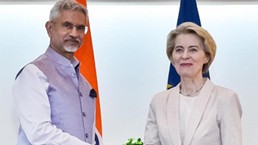
EU issued a document (Sept 2025) outlining 5-pillar agenda for India–EU ties ahead of leaders’ summit (Feb 2026).
Economy & Trade
- EU = India’s largest trading partner → Goods €120bn (↑90% in decade), Services €60bn (2024)
- 6,000 EU firms in India → 3m direct jobs, FDI €140bn (2023, 2× in 5 yrs)
- India <2.5% in EU trade; Indian investment in EU €10bn (low)
- Ongoing: FTA (by end-2025), Investment Protection Agreement, GI pact, Air Transport Agreement
- EU = Top investor; India = EU’s biggest Global South partner
Global Connectivity
- EU Global Gateway → €300bn infra fund; India → MAHASAGAR initiative
- EU-India Connectivity Partnership (2021) → basis for expansion
- Flagship: IMEC (India-Middle East-Europe Corridor) → maritime, rail, digital, energy, green hydrogen
- Blue Raman cable (11,700 km) → secure, resilient EU-Africa-India data corridor
- Green Shipping Corridors → sustainable maritime links, ↓ carbon dependence
Emerging Technologies
- EU strengths: R&D infra, regulation, green/digital tech
- India strengths: skilled workforce, big data, startups, frugal innovation
- Proposals → EU-India Innovation Hubs; Startup Partnership (EIC + Startup India)
- Focus → AI (LLMs, multilingual NLP, datasets, AI for healthcare, agri, climate)
- Safeguards → prevent misuse/unauthorized tech transfers
- Euratom–India R&D pact → nuclear safety, waste, security, fusion research
Security & Defence
- Strategic Dialogue on Foreign & Security Policy (launched Jun 2025)
- Cooperation → maritime security, cybersecurity, CT, non-proliferation
- Negotiations → Security of Information Agreement (classified data exchange)
- EU–India defence industry ties → joint R&D, supply chain resilience, competitiveness
- Proposed EU-India Defence Industry Forum (industry-led cooperation)
- Indo-Pacific alignment → EU naval coordination with Indian Navy in W. Indian Ocean
- Joint CT efforts → terror financing, online propaganda, narco-trafficking
People-to-People Ties
- Indians in EU (2023) → 8.25 lakh; EU Blue Card holders = largest group
- 2024 → 1m Schengen visas issued in India (many multi-entry)
- Migration mgmt → curb illegal flows, support balanced talent mobility
- Student exchanges → Erasmus+, Union of Skills, satellite campuses in India
- Qualification recognition & vocational training → systemic collaboration
- Context: EU attracting Indian students as US restricts visas (Trump policies)
Test Your Knowledge 03
Q3. Which of the following initiatives exemplify India–EU cooperation on global connectivity?
- India-Middle East-Europe Economic Corridor (IMEC)
- Blue Raman submarine cable system
- EU’s Global Gateway programme
- MAHASAGAR initiative
Select the correct answer using the code below:
(a) 1 and 2 only
(b) 1, 2, and 3 only
(c) 2, 3, and 4 only
(d) 1, 2, 3, and 4
Hint: All four are part of the India–EU connectivity partnership →
- IMEC = flagship corridor project.
- Blue Raman = digital submarine cable.
- Global Gateway = EU’s €300bn infra fund.
- MAHASAGAR = India’s maritime/infra initiative.
IE Explained: Karur crush death toll mounts: What leads to stampedes, why India sees so many of them
Syllabus: Pre/Mains – Disaster Management
Why in News?
→ Karur, TN: Stampede at TVK chief & actor Vijay’s rally; death toll mounting.
Causes of Stampedes in India
- Overcrowding triggers → Worship places, political rallies (esp. actor-politicians), festivals, railway stations, sporting events
- Immediate sparks → Fall from trees/structures (Karur), dropped luggage (NDLS), rumours (RCB victory parade)
- Systemic lapses → Poor planning, weak crowd-control, late rescue response, inadequate infrastructure
- Psychological factors → Panic spreads via non-verbal cues, ↑ density → ↓ personal space, delayed realisation of danger
- Physical causes of death → Mostly compressive asphyxia (rib cage pressure), domino falls → trampling
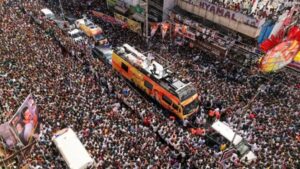
Recent Major Incidents (2025)
- Karur (Sep) → Vijay rally, crowd panic after tree fall → stampede deaths
- Bengaluru (Jun) → RCB IPL win parade; rumours + mismanaged entry → 12 deaths
- Goa (May) → Temple yatra stampede, multiple fatalities
- Delhi Railway Station (Feb) → Headload fall on FOB → 18 dead
- Prayagraj Kumbh (Jan) → Mauni Amavasya dip rush, 30 dead, 60+ injured
Scale & Data
- NCRB (2000–22) → 3,074 deaths; ~4,000 events since 1990s
- Annual toll → ~90 deaths in 2025 already
- Global vs India → Global examples (Seoul Halloween 2022, Germany Love Parade 2010) rare; India sees repetitive events due to larger scale + weak enforcement
Why India Sees More Stampedes?
- Event magnitude → Kumbh, yatras, political rallies → crowds in millions
- Star-politics culture → Actors-turned-politicians draw massive unmanaged gatherings
- Regulation gaps → Weak compliance, poor risk-mapping, limited emergency access
- Societal behaviour → Low regard for rules, high tolerance of dense crowds
Key Takeaways
- Pattern → Localised trigger → panic spread → delayed rescue → high casualties
- Core issue → Crowd size underestimation + lack of contingency planning
- Lesson from abroad → Rare repeats, corrective reforms; in India, recurrence persists
Preventive Measures: Way Forward
- Advance Planning → Crowd size mapping, scientific modelling, AI-based prediction
- Infrastructure → Wider exits, strong barricading, multiple entry/exit points, clear signage
- Tech Use → CCTV, drones, sensors for density monitoring, loudspeaker alerts
- Regulation → Strict event permits, liability norms, coordination b/w police–organisers–local admin
- On-ground Control → Trained marshals, volunteers, regulated queues, timed entry passes
- Emergency Response → Rapid medical teams, mobile hospitals, dedicated evacuation lanes
- Public Awareness → Stampede safety drills, do’s & don’ts messaging, behavioural nudges
- Learning from Global Models → Post-incident audits, no-repeat policy (as in Korea, Germany)
Test Your Knowledge 04
Q4. Which of the following are listed as responsibilities of State Governments under the Disaster Management Act, 2005, in relation to crowd-related disasters?
- Formulation of State Disaster Management Plan
- Ensuring district-level disaster preparedness
- Deployment of National Disaster Response Force (NDRF)
- Regulation of crowd management at local events
Select the correct answer:
(a) 1 and 2 only
(b) 1, 2 and 4 only
(c) 2, 3 and 4 only
(d) 1, 2, 3 and 4
Hint:
👉 NDRF deployment = Union Govt responsibility (not State).
👉 State’s role = planning (State DM Plan), ensuring district preparedness, regulating local events.
India clinches 9th Asia Cup title defeating Pakistan
Why in News?
India defeated Pakistan by 5 wickets in thrilling Asia Cup 2025 final to win record-extending 9th title.
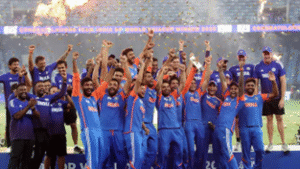
Celebration without Trophy
Details
- Venue: Dubai International Cricket Stadium, September 29, 2025
- Player of Match: Tilak Varma: Unbeaten 69* off 53 balls (3 fours, 4 sixes)
- Controversy: India refused to accept trophy from Pakistan’s Interior Minister Mohsin Naqvi
- Trophy presentation delayed over 1 hour, India walked off without silverware
- BCCI cited political tensions as reason for refusal
