
Kalam IAS Academy was founded by a team of committed individuals who believe that the traditional way of UPSC preparation needs to be changed.

TH News: Centre says right to vote different from freedom of voting
Syllabus: Pre/Mains – Polity & Governance
Why in News?
Centre’s affidavit in SC distinguishes “right to vote” ≠ “freedom of voting”, defending validity of uncontested election provisions under RP Act, 1951.

Core Legal Issue
- Petition by Vidhi Centre for Legal Policy + ADR → challenge to Section 53(2), RP Act, 1951 & Rule 11 + Forms 21/21B, Conduct of Elections Rules, 1961.
- Claim → violates Art. 19(1)(a) (freedom of expression) by denying voters chance to use NOTA in uncontested polls.
Govt’s Argument → “Right” vs “Freedom”
- Right to vote → ✦ Statutory, under Sec 62, RP Act, 1951 → limited by statute.
- Freedom of voting → ✦ Fundamental, under Art. 19(1)(a) → expression of opinion at the moment of casting vote.
- Quoted PUCL v. Union (2003) → vote = expression only when poll occurs.
- Hence, freedom of voting exists only if poll is held → “freedom of voting is an incidence of a poll”.
Application to Uncontested Polls
- Sec 53(2) → if candidates = seats, RO declares all “duly elected” → no poll conducted.
- Sec 53(1) → poll occurs if candidates > seats.
- Sec 53(3) → no poll if candidates < seats.
- Thus, NOTA inapplicable → since NOTA needs a poll to exist.
Position on NOTA
- Centre → NOTA ≠ “candidate” (Sec 79(b), RP Act) → cannot “contest”.
- Elections can’t be left indecisive; must declare winners where uncontested.
- EC’s affidavit → concurs; treating NOTA as candidate needs legislative amendment.
- Empirical note → only 9 uncontested elections (1951–2024) → issue limited but constitutionally significant.
Key Takeaways
- “Right to vote” = statutory entitlement
- “Freedom of voting” = expressive act under Art.19(1)(a)
- NOTA ≠ candidate → no scope in uncontested polls
- Sec 53(2) valid as per current statutory-constitutional framework.
Test Your Knowledge 02
Q. With reference to the Centre’s affidavit on uncontested elections, consider the following statements:
- The right to vote is a fundamental right under Article 19(1)(a).
- The freedom of voting—that is, the act of casting a vote—is treated as a form of expression under Article 19(1)(a).
- Both rights are derived directly from the Constitution.
Which of the statements given above is/are correct?
(a) 1 only
(b) 2 only
(c) 1 & 2 only
(d) 1, 2 & 3 only
Hint: ovt said freedom of voting arises only when poll occurs; NOTA ≠ candidate, hence no NOTA in uncontested polls.
TH Science: Karnataka’s menstrual leave policy: progressive step or symbolic gesture?
Syllabus: Pre/Mains – Society & Social Issues
Why in News?
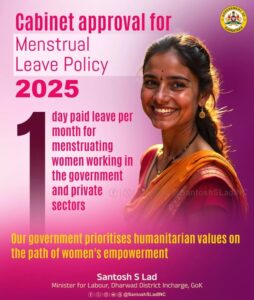
Karnataka clears 1 paid menstrual leave/month (12/yr) for all women across govt+private sectors—first such across-the-board State policy in India.
Policy Snapshot
- Scope → Govt depts, schools/colleges, factories, IT/MNCs, garments, private orgs; once notified.
- Quantum → 1 day/month → 12 days/yr; optional; SOPs via sub-committee.
- India context → Bihar (1992): 2 days/month for women govt staff; Kerala (2023): menstrual leave for university students.
- Private precedents → Zomato (2020): 10 days/yr; others (Culture Machine, etc.).
- Global refs → Japan (1947), S. Korea (2001), Indonesia (2 days first 2 cycle days), Taiwan (½ pay day/month), Spain (2023: 3–5 days with doctor’s note).
Rationale & Evidence
- Symptom burden → Dysmenorrhea prevalence 50–90% global; 60–75% India; ~45% moderate–severe.
- Productivity loss → Absenteeism 1.3 d/yr; presenteeism ↓productivity 23.2 d/yr → 8.9 d total loss/yr.
- Conditions → Endometriosis global cases ~22.3M (2021); major QoL/work impact; India prioritising econ burden research.
- Validation effect → Policy signals legitimacy of menstrual health → potential ↓stigma/↑morale (Spain/others as norm-setters).
Concerns & Critiques
- “1 day enough?” → Symptom peaks vary (some need 2–3 days); risk of symbolic relief only.
- Uptake reality → Spain first year: just 1,559 leaves in 11 months → barriers = diagnosis note, awareness, stigma.
- Bias risk → Potential employer hesitation on key roles; calls for explicit anti-retaliation clauses. (Policy debates & India op-eds).
- Administrative → Karnataka policy awaits notification; clarity needed on proof, tracking, and privacy.
Medical Guidance
- Don’t normalise severe pain → Seek gynae eval for recurrent heavy flow, dysmenorrhea, migraines. (Clinical consensus).
- Self-care (mild–mod) → Heat pads, hydration, light exercise, sleep hygiene, NSAIDs (OTC). (Standard advice; Indian studies).
- Treat root causes → Endometriosis/adenomyosis/fibroids → hormonal therapy, procedures, lifestyle, workplace adjustments.
Implementation & Safeguards
- Simple access → Self-declaration (no medical note) for day-of use; digital request; protect health data privacy. (Best-practice draws from Spain’s lesson).
- Anti-discrimination → No career penalty clauses; manager sensitisation modules; grievance channel. (Comparative HR guidance).
- Flex menu → Split leave (½-day x2), WFH/hybrid option, flexible hours; on-site amenities (rest space, sanitary products, heat packs). (Global policy reviews).
- Monitor & iterate → Quarterly dashboard: uptake %, departments, satisfaction, productivity; adjust 1→2 days cap if evidence supports. (Policy eval norms; India think-tanks).
Way Forward
- Pair leave + care → Workplace screening camps; referral tie-ups; insurance cover for gynae care; endometriosis awareness drives.
- Equity guardrails → Gender-neutral language for users of menstruation; opt-in disclosure; anonymised analytics only. (Comparative HR notes).
- Public benchmarking → List orgs adopting best SOPs; publish annual uptake & outcomes to normalise usage (learn from Spain’s low uptake).
Bottom Line
Strong signal on menstrual health  ; impact hinges on easy access (no-proof), anti-bias safeguards, and integrated women’s health services—else risks symbolism > substance.
Test Your Knowledge 03
Q. Which of the following countries has enacted a national menstrual leave law allowing up to five days of medical leave per month?
(a) Japan
(b) South Korea
(c) Taiwan
(d) Spain
Hint: Spain (2023) → first European nation; 3–5 days/month with doctor’s certificate; globally Japan, S. Korea, Indonesia, Taiwan also allow limited menstrual leave.
TH News: Trump’s nuclear test threat risks upending global test ban regime
Syllabus: Pre/Mains – Science & Tech
Why in News?
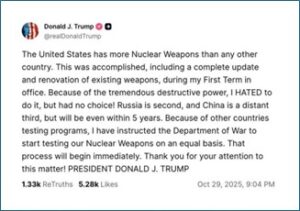
Trump (Oct 29) said U.S. will “start testing” nuclear weapons → threatens global test-ban norm.
Claims vs Facts
- Who’s testing? → DPRK (Democratic People’s Republic of Korea) yes; U.S./Russia/China moratorium since 1990s; recent Russian Burevestnik (SSC-X-9 “Skyfall”) & Poseidon (Status-6) tests ≠ nuclear detonations.
- U.S. line → Sec. of Energy (Nov 2): no return to explosive tests; only “subcritical” experiments under NNSA (National Nuclear Security Administration) Stockpile Stewardship Program.
Treaties & Legal Status
- PTBT (Partial Test Ban Treaty, 1963) → bans tests in atmosphere/space/underwater → underground only thereafter.
- CTBT (Comprehensive Nuclear-Test-Ban Treaty, 1996) → bans all nuclear explosions; signed U.S./China, not ratified; Russia ratified then de-ratified (2023) → norm weakened.
- CTBT EIF (Entry-Into-Force) hurdle → 8 Annex-2 states pending: U.S., China, Egypt, Iran, Israel (signed not ratified); India, Pakistan, DPRK (not signed).
- Verification → CTBTO (Comprehensive Nuclear-Test-Ban Treaty Organization)
- IMS (International Monitoring System): 337 planned facilities → seismic, hydro-acoustic, infrasound, radionuclide; global near-real-time data → rapid detection (e.g., DPRK 2006/2009/2013/2016/2017).
Arsenals & Test History
- Stockpiles (approx.) → Russia ~4,309; U.S. ~3,700; China >1,000 warheads (FAS).
- Historic test count → 2,056 total since Trinity (1945): U.S. 1,030; USSR/Russia 715; France 210; China >45; U.K. ~45; India 6 (1974, 1998); Pakistan 6 (1998); DPRK 6 (2006–2017).
- Last explosive tests → Russia 1990; U.S. 1992; China 1996; DPRK 2017 (claimed thermonuclear, very high yield).
What “Testing” Means?
- Full-scale nuclear test → supercritical chain reaction → validates new/modified warheads; enables MIRV miniaturization, yield tuning, hardening against ABM.
- Subcritical experiment → chemical explosives compress Pu-239/U-235 below criticality → materials science data; supports life-extension programs (LEPs) without violating CTBT norm.
- Alternatives → hydrodynamic tests, high-energy lasers (e.g., NIF—National Ignition Facility), advanced HPC (high-performance computing) → model validation without yield.
Environmental & Health Evidence
- Underground ≠ harmless → cavity collapse/venting → radionuclide release risk; aquifer/soil contamination.
- Case studies → Nevada Test Site “downwinders” (thyroid cancers/leukemia clusters); Semipalatinsk (Kazakhstan) ↑ congenital anomalies/cancer burden; Bikini Atoll (Castle Bravo, 1954, 15 Mt) long-term displacement & lagoon contamination.
- Persistence → long half-lives (Cs-137, Sr-90, Pu isotopes) → decades-centuries of risk.
Escalation Pathways
- Russia → stated reciprocity: U.S. tests → Russia tests → arms-race signaling.
- China → Lop Nur site readiness reports; parity drive vs U.S./Russia.
- South Asia coupling → China → India (Pokhran precedent: 1974 “Smiling Buddha”, 1998 “Shakti”) → Pakistan (Chagai-I/II, 1998) → action-reaction spiral.
- Extended deterrence → pressure on U.S. allies (Japan, ROK) policy debates ↑; proliferation resistance stress-test.
Strategic Consequences
- Norm erosion → CTBT credibility ↓; verification regime politicized; NPT (Treaty on the Non-Proliferation of Nuclear Weapons) trust deficit ↑.
- Force modernization race → MIRVs, hypersonic glide vehicles (HGVs), novel propulsion (nuclear-powered cruise) validated faster with tests.
- Crisis instability → test windows ↔ military exercises → misperception/accident risk ↑; signaling ambiguity.
- Diplomacy cost → sanctions/UNGA (United Nations General Assembly) resolutions; coalition frictions with non-nuclear states.
What to Watch (Indicators)?
- Site activity → NNSS (Nevada National Security Site), Novaya Zemlya (Russia), Lop Nur (China) → tunneling, power, logistics spikes.
- Seismic/radionuclide signatures → IMS detections, noble gases (Xe-133/135) → prompt attribution.
- U.S. policy docs → NPR (Nuclear Posture Review) updates, NNSA test-readiness timelines (e.g., 6–24 months signals).
- Parliamentary signals → Duma/Bundestag/US Congress funding lines; CTBT ratification debates (reversal/renewal).
- Regional rhetoric → India/China/Pakistan official statements; DPRK propaganda cycles.
Bottom Line
U.S. resumption of explosive tests → high probability of reciprocal tests (Russia/China) → South Asia knock-on → CTBT norm collapse, environmental harm, and accelerated global arms race.
Test Your Knowledge 04
Q. Which of the following statements regarding the Comprehensive Nuclear-Test-Ban Treaty (CTBT) are correct?
- It has entered into force after ratification by all five permanent members of the UNSC.
- India and Pakistan have not signed the CTBT.
- Russia ratified the CTBT but later withdrew its ratification.
Select the correct answer using the code below:
(a) 1 and 2 only
(b) 2 and 3 only
(c) 1 and 3 only
(d) 1, 2 and 3
Hint:
CTBT has not entered into force (U.S., China, Egypt, Iran, Israel, India, Pakistan, DPRK pending).
India & Pakistan have not signed.
Russia ratified but de-ratified in 2023
