
Kalam IAS Academy was founded by a team of committed individuals who believe that the traditional way of UPSC preparation needs to be changed.
IE Opinion: Indigenous people have the right to reject outside contact. We must respect their choice
Syllabus: Pre/Mains – Society & Social Issues
Why in News?
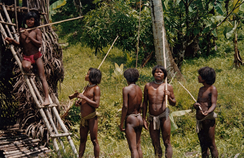
→ Survival International’s 2025 report warns that 196 uncontacted Indigenous groups remain worldwide, and half could disappear within ten years due to contact, disease, and land encroachment.
Indigenous Peoples in Isolation
- Present → 196 known groups; 95% in the Amazon (124 in Brazil, 64 in Colombia, Peru, Venezuela, Paraguay, Bolivia, Ecuador)
- Asia-Pacific → 4 in Indonesia; 2 each in the Andaman and Nicobar Islands and in West Papua
- Population size → Often below 100 people; some consist of only a few families
- Choice of isolation → Rooted in memory of genocide, enslavement, and epidemic deaths after earlier contacts
- Health impact → Over 80% die within a short time after contact (e.g., Matis tribe in Brazil)
- Awareness → They know of the outside world but consciously reject contact for safety
- Linguistic diversity → Many unique, undocumented languages facing extinction
- Ecological role → Their territories preserve some of the world’s most intact forests and biodiversity.
Historical Violence of Contact
- Early encounters → Hawaiians (1778, Captain Cook); Andamanese (1771, British mapping)
- Colonial myths → Marco Polo and Mandeville described islanders as monsters → early racism and dehumanisation
- Age of Exploration → Columbus and Vespucci’s voyages led to collapse of Aztec and Inca civilisations → millions killed
- Mechanisms → Disease transmission, slavery, forced conversion, and land seizure
- Consequence → Cultural and demographic annihilation, ecological devastation
- Continuity → Modern expansion projects and missionary efforts replicate colonial logic
Contemporary Threats and Violations
- Developmental intrusion → Logging, mining, oil drilling, road and dam building in Amazon and Southeast Asia
- Indian example → ₹92,000-crore Great Nicobar Project threatens extinction of the Shompen tribe
- Resource grab → Governments and corporations exploit land in the name of progress and national interest
- Missionary pressure → One in six uncontacted groups targeted by conversion attempts (Christian and Islamic)
- Example → John Allen Chau’s 2018 illegal entry to North Sentinel Island ended in his death
- Digital adventurism → YouTubers like Mykhailo Polyakov (2024) attempt illegal contact for online fame
- Cultural exploitation → Books romanticising the “uncontacted” (Goodheart, Kushner, Saraf) perpetuate colonial fantasies
Legal and Ethical Protections
- International covenants → International Covenant on Civil and Political Rights (1966); International Covenant on Economic, Social and Cultural Rights (1966); ILO Convention No. 169 (1989); United Nations Declaration on the Rights of Indigenous Peoples (2007)
- Core principle → Free, Prior and Informed Consent (FPIC) for any activity affecting their lands
- Indian approach → “Eyes-on, hands-off” policy for the Sentinelese demonstrates rare restraint
- Contradiction → Same government promotes the Great Nicobar Project violating FPIC and tribal sovereignty
- Brazil → FUNAI reserves created for no-contact protection → still violated by illegal miners and loggers
- Peru → 14 official reserves for isolated tribes → enforcement weak and inconsistent
The Case for Respecting Their Choice
- Survival → External contact brings death through disease, violence, and displacement
- Autonomy → Every group has the right to govern its ancestral land and decide its own destiny
- Cultural significance → They embody living traditions of balance, self-sufficiency, and harmony with nature
- Global responsibility → Their protection safeguards biocultural diversity essential for the planet’s ecological health
- Moral responsibility → Respecting their refusal to engage with outsiders represents respect for freedom itself
Essence
Protecting the right of Indigenous peoples to remain uncontacted is not isolationism—it is recognition of their sovereignty, their knowledge systems, and humanity’s moral obligation to preserve the last truly free societies on Earth.
Test Your Knowledge 01
Q. Consider the following pairs:
Region → Indigenous group (uncontacted)
Andaman Islands → Sentinelese
Great Nicobar → Shompen
Brazil → Matis
Which of the above pairs is/are correctly matched?
(a) 1 and 2 only
(b) 1 and 3 only
(c) 2 and 3 only
(d) 1, 2 and 3
Hint:
- Sentinelese (Andaman Islands) → Fully uncontacted; protected by “eyes-on, hands-off” policy; violent rejection of outsiders.
- Shompen (Great Nicobar) → Semi-isolated forest tribe; threatened by ₹92,000-crore Great Nicobar Project.
- Matis (Brazil, Amazon) → Contacted tribe; 80% died of disease post-contact; now symbol of post-contact collapse.
IE Opinion: ASEAN is an economic powerhouse that must resolve its contradictions
Syllabus: Pre/Mains – International Relations
Why in News?
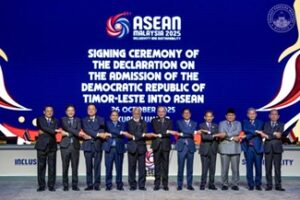
47th ASEAN Summit (Kuala Lumpur, Oct 26) → Thai–Cambodia “peace deal” inked; Timor-Leste admitted as 11th member.
ASEAN: Scale & Geo-economics
- Scale → ~700 mn ppl; GDP > $4 tn; growth ≈ 25% ↑ vs global avg
- Origins/centrality → Born 1967 post-Konfrontasi; ARF/EAS convening ✦; Indo-Pacific actors (incl. India) back “ASEAN centrality”
- Trade ties → China = #1 trading partner (15+ yrs); US & EU next
- FDI flows (2023) → US $74.4 bn (#1) → EU $24.9 bn → China $17.3 bn; 6,000+ US firms in region
- Value chains → Exports (final goods) → US; imports (intermediates) ← China; new ASEAN–China FTA + RCEP → deeper integration
Recent Shocks/Headwinds
- Tariffs → New US tariffs → export-led members disrupted (allies & others)
- Aid cuts → USAID ↓ → public health & R&D projects hit
- Inequality → Older/richer vs newer/poorer members → dev. & capacity gaps
- Governance strain → Myanmar crisis since 2021 → 5-Point Consensus falters; credibility cost
Thailand–Cambodia Flare-up → Ceasefire
- Dispute DNA → Colonial-era maps; Preah Vihear temple (ICJ to Cambodia); 817-km undemarcated stretches
- July 2025 clash → 5 days; >40 dead; ~3,00,000 displaced; rockets & airstrikes; leaked call → Thai PM out
- Mediation → ASEAN chair (Malaysia) leads; US pressure; China observer → ceasefire July 28; expansion Oct 26 (Summit D-1)
- Deal terms → 2-page “declaration” (Thai label): AOTs to verify; heavy-weapons pullback (started; deadline: year-end); landmine clearance; anti-scam ops; joint border-area mgmt framework
- Politics–economy → Manage ultranationalists; prevent trade/supply disruptions
- Sidelines → Cambodia PM nominates US President Trump for Nobel; Thailand–US rare earths pact
Strategic Contradictions to Resolve
- Dual dependencies → Econ ↑ with China vs security/FDI links with US → policy tightrope
- Protectionism vs integration → US tariffs/aid cuts ↔ ASEAN–China FTA/RCEP deepening
- Centrality vs capacity → Convening power ✦ but weak enforcement (Myanmar, borders)
- Convergence vs diversity → Wide dev. gaps/political variety → uneven integration pace
Strategic Implications (Region & India)
- Region → Need supply-chain recalibration; compliance mechanisms for peace deals; landmine/scam suppression as trust builders
- Markets → Diversify export baskets; upgrade rules-of-origin/standards; invest in health-R&D insulation
- India ↔ ASEAN → Cornerstone of Act East; ops in connectivity, digital/public health, resilient value chains; back ASEAN-led forums & crisis mediation.
Test Your Knowledge 02
Q. Assertion (A): ASEAN maintains strong defence/security links with the US even as China’s economic footprint rises.
Reason (R): ASEAN seeks to hedge against great-power risks by diversifying alignments.
(a) A and R true; R correct explanation
(b). A and R true; R not the explanation
(c). A true; R false
(d). A false; R true
Hint: Both A and R are true, and R exactly explains A (hedging strategy = reason for dual links).
IE Explained: Crisis in Sudan: Current trigger, old faultlines, and the human cost
Syllabus: Pre/Mains – International Relations
Why in news?
Fresh massacres in Darfur/El Fasher → ethnic killings; camps (Zamzam) report Famine (IPC-5)
2+ years of Sudanese Armed Forces vs Rapid Support Forces → conflict deepens; diplomacy stalls
Trigger & trajectory
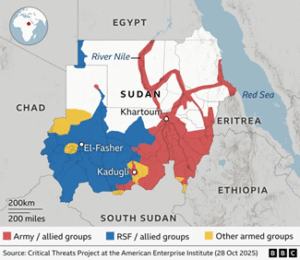
- 15 Apr 2023 → spark over force integration/control of state revenue → coup allies turn rivals
- Spread → Khartoum/Omdurman → Darfur/Kordofan/Gezira; sieges, air/artillery strikes, looting
- Territory → Rapid Support Forces hold Darfur + gold/trade routes; Sudanese Armed Forces hold Port Sudan/central corridors → stalemate
Human toll, geography & services
- Deaths → ≈150,000 (range wide) → mass atrocities esp. against Massalit/Fur/Zaghawa
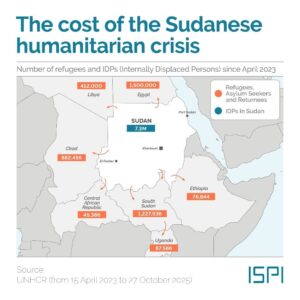
- Displacement ↑ → ~13 million total; 8.8 million internally displaced persons; 3.5 million refugees (Egypt ~1.5 million; Chad >770,000)
- Health collapse → >70% facilities in conflict zones nonfunctional; medicine/fuel/water scarce
- Disease → cholera/malaria/measles outbreaks; water, sanitation and hygiene breakdown
- Education/Protection → schools shut; gender-based violence/child recruitment ↑
- Markets → Gezira agriculture hit; prices ↑; banks/depots looted; households ration sorghum/lentils
- Routes & camps → El Fasher/Zamzam famine; White Nile camps overcrowded; desert treks to Chad
Core Isssues
- Security-sector dualism → parallel chains of command; no credible security sector reform
- War economy → gold/cross-border smuggling (Rapid Support Forces) vs ports/irrigation rents (Sudanese Armed Forces) → spoilers’ incentives
- Ethnic faultlines → Janjaweed legacy; center–periphery neglect; impunity cycles
- Resource stress → land–pasture–water rivalry + climate shocks (drought/flood) → farmer–herder clashes
- External enablers → alleged support links: United Arab Emirates/Egypt/Russia (gold, arms, logistics)
- Diplomacy gaps → fragmented mediations/sanctions; humanitarian access blocked/looted
- Funding shortfall → United Nations plan <⅓ funded → pipelines for food/health falter
Way Forward
- Protect civilians → ceasefire rings around hospitals/IDP camps; independent monitoring
- Open aid at scale → cross-line & cross-border corridors; air/river options; deconflict routes
- Health/WASH surge → oral cholera vaccine, measles campaigns; water, sanitation and hygiene kits; fuel for cold-chain
- Food/cash → rapid IPC-5 targeting; vouchers/mobile money; restore school feeding
- Finance levers → choke gold/contraband networks; tighter export, aviation, customs controls; targeted sanctions
- Political track → single mediation; benchmarks for security sector reform; phased force integration under civilian oversight; atrocity accountability
- Support neighbors → Egypt/Chad/South Sudan reception & registration capacity; anti-trafficking safeguards.
Test Your Knowledge 03
Q. Which of the following countries did NOT receive major refugee inflows from Sudan during 2023–25?
(a) Egypt
(b) Chad
(c) Libya
(d) Eritrea
Hint: Major refugee inflows from Sudan went to Egypt (~1.5 million), Chad (>770,000), South Sudan, Libya, Ethiopia, Uganda.
Eritrea shares a border but received minimal inflow due to tight border controls & limited humanitarian access
