
Kalam IAS Academy was founded by a team of committed individuals who believe that the traditional way of UPSC preparation needs to be changed.

IE Explained: Blood Moon tonight: What is it, how to watch, why you should care, in 5 points
Syllabus: Pre/Mains – Geography
Why in News?
Total lunar eclipse (Blood Moon) occurred on September 7–8, 2025, offering a rare, long 82-minute totality visible across India and much of the Eastern Hemisphere.
What is a lunar eclipse?
- Earth aligned between Sun & Moon
- Moon passed through Earth’s umbra (darkest shadow) → total eclipse
- Safe to watch with naked eye, unlike solar eclipse
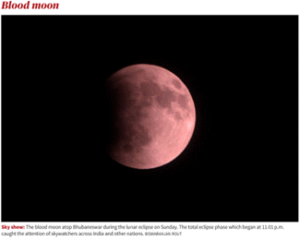
What makes it a Blood Moon?
- Sunlight filtered through Earth’s atmosphere
- Rayleigh scattering: blue light scattered away, red/orange reach the Moon
- Atmosphere’s dust/pollution makes hue deeper red
Eclipse timeline (India, IST)
- Penumbral begins ~ 8:58 PM
- Partial begins ~ 9:57 PM
- Total begins ~ 11:00 PM
- Peak (max totality) ~ 11:41 PM
- Total ends ~ 12:22 AM
- Partial ends ~ 1:25 AM; Penumbral ends ~ 2:25 AM
Why it matters?
- One of the longest totalities of the decade (~82 minutes)
- Photogenic and communal spectacle—wide public interest, no special gear needed
- Scientific insight: hue depth hints at Earth’s atmospheric conditions (e.g. volcanic ash)
- Same physics explains blue skies and red sunsets
IE Opinion: What India should do to build climate-resilient cities
Syllabus: Pre/Mains – Environment
Why in News?
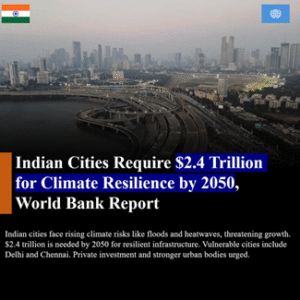
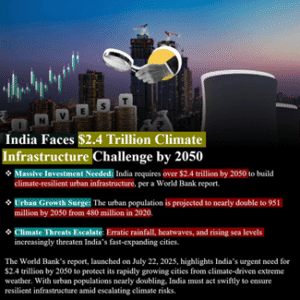
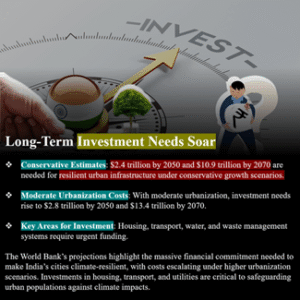
The World Bank’s new report “Towards Resilient and Prosperous Cities in India” estimates Indian cities need $2.4 trillion by 2050 (rising to ~$10.9 trillion by 2070) for climate-resilient, low-carbon urban infrastructure amid escalating threats from heatwaves and flooding.
Key Themes & Subpoints
Urgent Scale & Risk
- Urban population projected to nearly double: ~480 million (2020) → ~951 million (2050), ~1.1 billion (2070)
- Over 50% of urban infrastructure for 2050 is yet to be built
- Heat: night-time urban temps are 3–4 °C hotter than rural areas
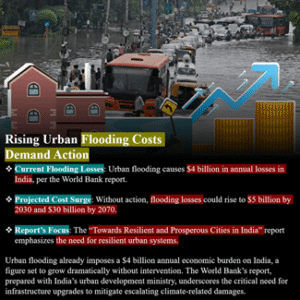
- Flood risks (pluvial, coastal, fluvial) rising; annual flood losses may grow from ~$4 billion now → ~$5 billion (2030) → $14–30 billion (2070)
- Heat-related deaths could more than double (>144 k → >328 k by 2050)
- Job generation: ~70% of new jobs by 2030 expected in cities
Investment Needs & Financing
- $2.4 trillion needed by 2050; ~$10.9 trillion by 2070 (conservative)
- Current urban infrastructure spending ≈ 7% of GDP—far below global norms
- Less than 5% of investment is from private sector
Strategic Responses
Urban design & infrastructure:
- Better storm-water regulation
- Green spaces, cool roofs, early warning systems
- Flood-resilient transport networks, resilient municipal services (water, waste)
Institutional reforms:
- Strengthen coordination across federal, state, and local levels
- Enhance autonomy of Urban Local Bodies (ULBs)
- Create dedicated urban resilience programmes, financing roadmaps
Private sector mobilization:
- Green bonds, blended finance, international climate funds
- Engage as key partners in service delivery and innovation
Impact & Opportunities
- Flood adaptation could avert ~$5 billion losses annually by 2030, ~$30 billion by 2070
- Heat mitigation measures could save ~130,000 lives and boost GDP by up to 0.4%
- Resilient cities attract investment, generate jobs, foster innovation, and build inclusive prosperity
Prime Minister recalls vision of Sree Narayana on his birth anniversary
Why in News?
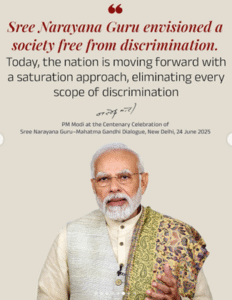
PM Modi paid tribute to Sree Narayana Guru on his birth anniversary (September 7th, 2025) through social media posts.
Sree Narayana Guru – Key Overview
Life & Background
- Born 22 August 1856 in Chempazhanthy village, Kerala to Madan Asan and Kuttiyamma.
- From the Ezhava caste (lower caste), experienced caste discrimination firsthand.
- Died 20 September 1928.
Education & Spiritual Journey
- Studied Sanskrit and Ayurveda, learned Vedic philosophy and Upanishads.
- Spent 8 years in meditation at Maruthwamala cave after wandering through Kerala and Tamil Nadu.
- Emerged as enlightened spiritual leader.
Revolutionary Temple Movement
- 1888: Consecrated Shiva temple at Aruvippuram – first non-Brahmin to install temple deity.
- Broke centuries-old caste barriers in temple worship.
- Built 40+ temples across Kerala open to all castes.
- Temple message: “One caste, one religion, one God for mankind”.
Social Reforms & Organizations
- 1903: Founded SNDP Yogam with Dr. P. Palpu focusing on education, organization, economic empowerment.
- Led Vaikom Satyagraha against caste discrimination.
- 1904: Established Sivagiri Ashram near Varkala.
- 1924: Created Sivagiri Foundation.
Educational Revolution
- Opened schools for lower castes regardless of background.
- Founded Sanskrit school in Varkala for poor boys and orphans.
- Created education facilities at temple premises.
Core Philosophy
- “One in Kind, One in Faith, One in God, is Man”
- “Whatever be the religion, it suffices if it makes a better man”
- Promoted universal brotherhood, social equality, and non-violent philosophy.
Legacy & Recognition
- Influenced Mahatma Gandhi and Rabindranath Tagore.
- Transformed Kerala society through spiritual and social reforms.
- Wrote philosophical works, poems, hymns in Malayalam and Sanskrit.
